Clay bar treatment is widely mentioned in detailing circles but rarely explained in terms of what actually happens to your car when it's skipped. This article covers the practical case for clay barring: what it does, what's at stake when it's left out, and why Dubai's environment makes it more relevant here than in most places.
Key Takeaways
- Clay bar treatment removes bonded contaminants that regular washing leaves behind — brake dust, rail dust, and industrial fallout included
- Skipping it means wax, sealants, and ceramic coatings bond to contamination rather than paint, reducing their durability
- Dubai's 45°C summers and high PM10 particulate levels accelerate contamination buildup compared to milder climates
- Clay barring is a preparation step; schedule it every 6–12 months as part of a consistent detailing routine
- Left untreated, contamination progresses from surface roughness to micro-scratches to clear coat etching — and that means expensive professional correction
What Is Clay Bar Treatment?
A clay bar is a pliable synthetic resin compound — 3M's technical data sheet lists the composition as roughly 50–55% calcium carbonate, 35–40% polymer resin, and pigments — used with a dedicated lubricant to physically pull bonded surface contaminants out of the clear coat.
What it targets specifically:
- Brake dust and rail dust (airborne iron particles)
- Industrial fallout and metallic particulates
- Paint overspray and road tar
- Tree sap residue and road paint spatter
Clay barring happens after washing and before any polish, wax, sealant, or ceramic coating. Washing removes loose surface dirt; clay removes what remains chemically bonded to the paint after washing. That makes it a decontamination step, not a cleaning one.
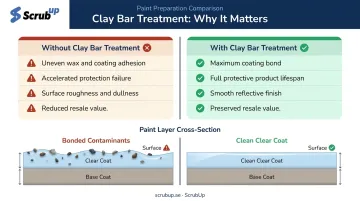
Without this step, wax, sealant, or ceramic coating bonds over embedded contaminants rather than bare paint — reducing adhesion and cutting protective life short.
Key Advantages of Using a Clay Bar on Your Car Paint
Advantage 1: It Removes What Washing Cannot
Regular washing handles loose surface contamination. It doesn't touch what has bonded to the clear coat.
3M explicitly states that its cleaner clay removes bonded contaminants from automotive paint that may remain after washing alone — including rail dust, brake dust, industrial fallout, paint overspray, and road grime. Toyota's 2023 technical service bulletin defines rail dust as airborne iron particles from railroad tracks, train wheels, heavy machinery, grinding, and welding, and warns that polishing or buffing iron-contaminated surfaces will cause further damage because of particle abrasiveness.
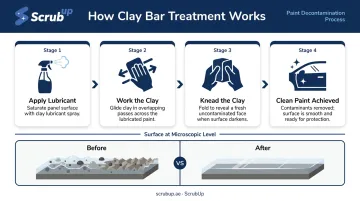
How the clay bar works in practice: using a dedicated lubricant, the pliable clay is worked across the panel surface with light, overlapping strokes. The resin matrix grabs and lifts embedded particles as it passes. The clay is kneaded and folded regularly to expose a clean face. A freshly washed but contaminated panel will feel rough at the start; it transitions to smooth as contamination clears.
In Dubai, the accumulation rate is faster than in most cities. The UAE National Air Quality Agenda 2031 identifies PM10 particulate matter as a national air quality concern, strongly influenced by the country's arid, windy climate, with dust storms classified as inevitable high-level pollution episodes. A 2024 research paper in Atmospheric Environment: X puts Dubai's total average PM10 concentration at approximately 106 µg/m³ across a 16-year period — well above typical urban benchmarks. Construction, transport, and industrial processes all contribute.
Vehicles parked outdoors, driven near construction zones, or located in areas like Dubai Industrial City or Al Jaddaf face the sharpest accumulation. The contamination is invisible but actively degrades the clear coat beneath.
Advantage 2: It Maximizes the Effectiveness of Wax, Sealants, and Ceramic Coatings
Any protection product — wax, paint sealant, or ceramic coating — must bond directly to the paint surface to perform as intended. On a contaminated surface, the product bonds to the contamination layer instead. The result: uneven coverage, reduced adhesion, and a shorter effective lifespan.
Clay barring removes that contamination layer entirely, leaving a chemically clean surface that allows protective products to make direct contact with the clear coat.
CARPRO, a ceramic coating manufacturer, lists the full preparation sequence before applying its CQUARTZ nanotech coatings as:
- Washing
- Decontamination
- Oil residue removal
- Water spot removal
- Claying
- Polishing
Its Eraser product is specifically described as ensuring maximum bonding performance of the coating. Ceramic Pro similarly confirms that clay bar treatment removes bonded contaminants as part of the detailing process before protection steps.
Why this matters financially: ceramic coating is a significant investment. Applied over a contaminated surface, the coating's durability is compromised from day one — not because the product failed, but because the preparation was skipped. The same applies to paint sealants and wax. The product cost is wasted on a bond that will fail ahead of schedule.
For any vehicle being prepared for paint protection — especially ceramic coating — clay barring determines whether that investment holds or fails prematurely.
Advantage 3: It Preserves Paint Appearance and Supports Resale Value
The visible result of clay barring is immediate: a smooth, clear surface that reflects light more evenly, making colours appear deeper and more vibrant. Wax and polish then amplify this, but only if the foundation is clean.
Over time, the compounding effect is substantial. Vehicles that receive consistent decontamination as part of their detailing routine show less surface oxidation, fewer embedded stains, and cleaner clear coat over years compared to vehicles that are washed regularly but never decontaminated.
Paint condition has a direct bearing on resale value. In Dubai's used car market — where platforms like dubizzle and CarSwitch show buyers actively filtering by condition — a clean, defect-free paint finish commands a measurable premium. Paint defects including surface oxidation, embedded staining, and clear coat damage reduce a car's appeal and often require costly professional correction before sale.
In Dubai's used car market, where luxury vehicles are common and condition-sensitive buyers are active, a well-maintained paint finish carries real value at the point of sale. Clay barring is one of the most cost-effective ways to protect it — quick to complete, inexpensive relative to alternatives, and cumulative in benefit over years of ownership.
What Happens When Clay Bar Treatment Is Skipped
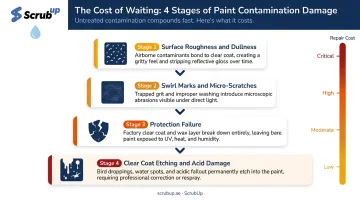
The consequences are progressive, not sudden.
Stage 1 — Surface roughness and dullness: Contaminants accumulate in layers on the clear coat, creating microscopic texture. The paint loses its depth and reflective quality. This is the stage most owners notice but misattribute to aging.
Stage 2 — Swirl marks and micro-scratches: Subsequent washing drags bonded particles across the surface. Even with quality wash mitts, the particles act as abrasives. Swirl marks deepen with each wash cycle.
Stage 3 — Protection failure: Wax and sealants applied over contaminated paint create an uneven, shortened-lifespan barrier. Owners notice water no longer beads properly, or that the car dulls again quickly after a detail. The root cause is rarely identified.
Stage 4 — Clear coat etching: Mazda's technical service bulletin on iron particle paint damage states that moisture and temperature acting on bonded iron particles can generate acids that corrode and penetrate the paint. Once this occurs, clay treatment alone is insufficient.
The bulletin notes that its decontamination products are designed for contamination under 120 days of exposure. Longer exposure may require repeated procedures or, if polishing removes more than 0.3 mil of paint film, a full clear coat respray.
Repainting is not a minor expense. According to AAA, professional repainting in the US ranges from $300 to over $20,000 depending on scope, with mid-grade work running $1,000–$4,500 (roughly AED 1,100 to AED 60,000 at current rates). In Dubai, premium paint correction and respray costs follow a similar curve. Skipping decontamination early is often what puts a car on that trajectory.
How to Get the Most Value from Clay Bar Treatment
Frequency: Every 6–12 months is a workable baseline for most vehicles. In Dubai, vehicles parked outdoors, driven near construction, or based in high-traffic industrial areas should lean toward the shorter end of that range. The simplest test: run a clean finger across a freshly washed panel. If it feels rough or gritty, the surface needs clay.
Process essentials:
- Wash the vehicle thoroughly first — clay barring should never be done on a dirty surface
- Use a dedicated clay lubricant throughout — not water, not soapy water
- Work one panel at a time with light, overlapping pressure
- Knead and fold the clay regularly to expose a clean face
- Discard the bar immediately if dropped — any ground contact introduces abrasives that will scratch paint
- Follow with polish, wax, sealant, or ceramic coating while the surface is clean
The DIY challenge in Dubai: heat and dust complicate outdoor detailing. Clay dries out faster in high temperatures, lubricant evaporates more quickly, and ambient dust can settle on a panel mid-treatment. A shaded or covered space — a basement parking bay, for example — keeps conditions stable enough to work through each panel properly.
Clay barring works best on a genuinely clean surface. ScrubUp's mobile car wash comes directly to your parking spot across Dubai, so your vehicle arrives at each treatment stage properly prepped — without you needing to drive anywhere or wait in a queue.
Conclusion
Clay bar treatment controls the one thing all other paint protection steps depend on: surface cleanliness. Skip it, and washing, waxing, and coating all underperform — not because they're poor products, but because they're applied to a compromised surface.
Those surface gains compound over time. A vehicle decontaminated consistently stays in better condition longer, needs fewer corrective treatments, and holds its appearance and resale value better than one that's simply washed. In Dubai's dust-heavy, heat-accelerated environment, that gap between maintained and neglected paint widens faster than it would almost anywhere else.
Clay barring is an ongoing discipline. Done consistently, it pays off in finish quality and extends the life of every protective product applied afterward.
Frequently Asked Questions
What does clay do for car detailing?
Clay physically removes bonded surface contaminants (brake dust, rail dust, industrial fallout, and overspray) that regular washing cannot reach. It leaves paint genuinely smooth at a microscopic level, making it properly ready for polishing or the application of any protective product.
What type of clay is used for car detailing?
Detailing clay is a synthetic resin-based compound, available in fine, medium, and heavy grades depending on contamination severity. Fine-grade clay suits regularly maintained vehicles; medium or heavy grades are used for more severe contamination or ahead of paint correction work.
How long does a clay bar last?
A single clay bar typically treats 10–20 vehicles depending on contamination level and how carefully it's maintained. Synthetic alternatives like clay mitts and pads last significantly longer, especially when stored in a sealed container with lubricant between uses.
How often should I clay bar my car?
Every 6–12 months as a general guideline. Vehicles parked outdoors, driven in high-dust or industrial areas, or located in Dubai, where airborne particulates accumulate quickly, benefit from treatment closer to every 6 months. The touch test on a freshly washed panel confirms when it's needed.
Can a clay bar remove scratches or swirl marks?
No. Clay removes bonded surface contamination only. Scratches and swirl marks require polishing or paint correction. A clay-barred surface does make polishing more effective, since the abrasive is working on clean paint rather than contamination.
Do I need to clay bar before applying wax or ceramic coating?
Yes. Protection products bond to whatever is on the surface — applying them over contamination prevents proper adhesion, reduces durability, and wastes the cost of the product. Always clay bar directly before applying any protection product.