Introduction
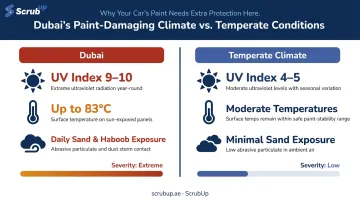
Dubai's climate is genuinely hostile to car paint. A UV index that regularly hits 9–10 (Very High) in summer, temperatures recorded at 45°C by the UAE National Centre of Meteorology, and frequent sandstorms combine to create conditions that degrade unprotected paintwork faster than most climates on earth.
Without protection, clear coats oxidise, fade, and lose scratch resistance within a few years. Sand particles act as a natural sandblast on exposed panels. Heat makes clear coat more porous, letting contaminants etch in deeply.
This guide covers everything Dubai car owners need: why local conditions are uniquely damaging, which protection options suit different budgets, how to spot when protection is failing, and a practical maintenance schedule to keep it working long-term.
Key Takeaways
- Dubai's UV and heat accelerate paint oxidation significantly faster than temperate climates
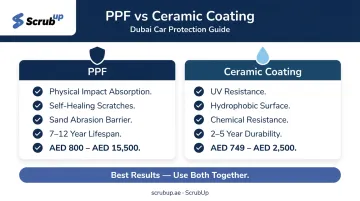
- PPF handles physical impact while ceramic coating blocks UV, chemicals, and contamination — together they offer the most complete protection
- Standard automated brush washes are one of the fastest ways to void a coating warranty
- Wash every 7–10 days using pH-neutral products and microfibre materials
- After any sandstorm, rinse or encapsulate particles before touching the paint
Why Car Paint Protection Is Essential in Dubai
UV Radiation and Heat Do Real Damage
Dubai's UV index reaches 9 in June and July, compared to just 5 in London during the same months — nearly double the radiation load hitting your paint daily. According to a peer-reviewed study on automotive clear coats, UV exposure causes photodegradation and chain scission in clear coat layers, reducing gloss and scratch resistance measurably over time.
Heat compounds this. The same research found that midnight-black base coats can reach 83.3°C on the surface — sustained at that temperature, clear coat embrittles and loses its protective properties.
Once paint becomes this porous, bird droppings, industrial fallout, and hard-water minerals etch into the surface far more deeply than they would in cooler climates.
Sand: A Slow, Constant Grind
Fine desert dust settles on every panel every single day. Wiped or washed incorrectly, those particles act as micro-abrasives, dragging across the clear coat and leaving a network of fine scratches that progressively dull the finish.
A haboob accelerates this dramatically. Research published in the journal Wear identifies solid-particle erosion as causing pitting, plowing, flaking, and cracking in automotive paint coatings — and UV-weathered paint shows measurably reduced resistance to this abrasion. An unprotected car parked through a single Dubai sandstorm can sustain the kind of surface damage that typically accumulates over years.
The Financial Case
Protection isn't just aesthetic — it's a financial decision. Typical repair costs in Dubai include:
- Paint correction: AED 1,500–7,000 depending on severity
- Full respray: from AED 2,000 (sedan) to AED 3,500+ (SUV)
- PPF + ceramic coating package: less than a single major correction job over the vehicle's lifespan
Applied early and maintained properly, a protection package consistently costs less than reactive repair. It also supports resale value in a UAE used-car market worth over AED 9.2 billion — where paint condition directly affects what buyers will pay.
Types of Car Paint Protection Available in Dubai
The right choice depends on your budget, vehicle type, and driving patterns. Many owners get the best results by combining options.
Paint Protection Film (PPF)
PPF is a thick, transparent urethane film bonded directly over painted surfaces. It works as a sacrificial layer, absorbing rock chips, scratches, and sand abrasion before they reach the paint underneath.
Key features:
- Minor surface scratches self-heal with heat exposure (sunlight or engine warmth)
- Prevents UV-driven yellowing of the underlying paint
- Applies to high-impact zones only (hood, bumper, mirrors) or full-body
- Lasts 7–12 years depending on product tier — 3M Pro Series carries a 10-year warranty, LLumar Valor offers 12 years
Current Dubai pricing:
- Individual panels (hood, bumper): AED 800–1,400
- Front-end packages (hood, bumper, fenders, headlights): AED 2,500–5,500
- Partial front packages: AED 3,500–9,000 depending on vehicle size
- Full-body coverage: AED 6,500–15,500 for sedans and SUVs
Ceramic Coating
Ceramic coating is a liquid nano-polymer that chemically bonds with the clear coat, forming a hard, glass-like layer. It doesn't absorb physical impacts. Its strengths are UV resistance, chemical resistance, and a hydrophobic surface that makes water and contaminants bead off cleanly.
That hydrophobic effect matters particularly in Dubai — water, dust, and sand slide off easily rather than bonding to the surface. The car stays cleaner longer, and each wash carries less abrasion risk.
Typical durability is 2–5 years for professional-grade products. Gtechniq's Crystal Serum Ultra carries a 9-year professional warranty.
Current Dubai pricing:
- Entry-level (1-year protection): from AED 749
- Mid-range (3-year): AED 899–1,800
- Premium (5-year+): AED 1,800–2,500
Ceramic coating does not protect against rock chips or physical impact. For full coverage, it works best alongside PPF on high-impact zones.
Car Wax and Paint Sealants
Wax and synthetic sealants are entry-level options offering basic UV and hydrophobic protection. In Dubai's conditions, they need reapplying every 1–3 months — making them impractical as standalone protection for most owners.
That said, they do serve two practical purposes:
- Maintenance top-up layers over existing ceramic coating
- A lower-cost solution for newer vehicles where full PPF or ceramic investment isn't justified yet
Signs Your Car's Paint Protection Needs Attention
Catching degradation early protects the paint underneath and avoids the cost of full correction and recoating.
Performance Warning Signs
- Water no longer beads: If water sheets flat rather than forming tight droplets that roll off, the hydrophobic layer has thinned or failed
- Dull or hazy finish under direct sun: The protective layer is no longer reflecting light cleanly
- Rough texture on the painted surface: A properly coated panel should feel glassy — roughness suggests contamination has bonded to or through the coating
Physical Damage Indicators
- Yellowing, lifting edges, or visible bubbling on PPF (these are also covered under most manufacturer warranties)
- Swirl marks or scratches breaking through ceramic coating, indicating the hard layer has been worn down
- Localised oxidation or discolouration on panels that were previously covered
Timeline Triggers
Even without visible damage, age alone is enough reason to act. If your PPF is past 7–10 years or your ceramic coating is beyond 3–5 years, book a professional inspection. UV exposure and washing cycles degrade protection gradually, so a detailer can assess hydrophobic performance and coating integrity before any permanent paint damage occurs.
How to Maintain Your Car's Paint Protection in Dubai
Washing Frequency and Method
In Dubai's dust levels, every 7–10 days is the minimum wash interval. Ceramic Pro recommends washing coated vehicles every two weeks to prevent contamination buildup — in sandier conditions or with outdoor parking, more frequent washing is justified.
Every wash should use:
- pH-neutral shampoo (avoid anything below pH 5.0 or above pH 9.0)
- Microfibre mitts and drying towels — no sponges, chamois, or hard cloths
- Two-bucket method or pre-rinse before contact to reduce abrasive particle contact
Why Automated Brush Washes Are a Problem
Standard automatic car washes use rotating brushes and high-alkaline chemicals. These strip ceramic coatings, lift PPF edges, and introduce swirl marks into the clear coat. Most ceramic coating manufacturers — including Ceramic Pro — explicitly state that brush washes can void product warranties.
For Dubai owners with coated or PPF-covered vehicles, the practical alternative is hand washing, touchless washing, or a professional mobile service.
ScrubUp's mobile car wash delivers pH-balanced foam and waterless cleaning directly to your parking spot across Dubai, using microfibre materials and biodegradable, coating-safe products — with no brush contact and no need to drive anywhere. Their Eco Wash service uses lubricated waterless cleaners that encapsulate dust and sand particles before removal.
Post-Sandstorm Protocol
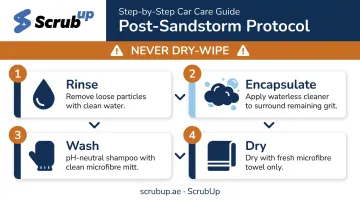
After a sandstorm, never dry-wipe. Dragging abrasive sand particles across a coated surface without lubrication causes micro-scratches even through PPF and ceramic layers. The correct sequence:
- Rinse the vehicle with clean water first to remove loose particles
- Apply a coating-safe waterless cleaner or foam to encapsulate remaining grit
- Wash with pH-neutral shampoo using a clean microfibre mitt
- Dry with a fresh microfibre towel
Parking Habits
Covered or basement parking makes a measurable difference. Continuous direct sun exposure in Dubai's summer affects coated and PPF-covered paint in several ways:
- Accelerates UV degradation of both ceramic coating and PPF
- Shortens the effective lifespan of the protection layer
- Increases the risk of contaminant etching on hot surfaces
Where possible, prioritize shaded or underground parking — especially during peak summer months.
Professional Inspection and Top-Up
Annual professional detailing visits extend the life of any protection system. A trained detailer can:
- Apply a ceramic coating top-up layer to restore hydrophobic performance
- Re-seal lifting PPF edges before they spread
- Perform paint correction if micro-scratches have accumulated, before recoating
Car Paint Protection Maintenance Schedule
The right frequency depends on your driving habits, parking conditions, and protection type. In Dubai's heat, dust, and UV intensity, even well-protected cars need more consistent attention than they would in milder climates.
| Frequency | Task |
|---|---|
| Every wash (7–10 days) | pH-neutral shampoo or encapsulating waterless cleaner; microfibre materials only; inspect for new chips, scratches, or lifting film edges |
| Monthly | Apply ceramic spray booster or quick detailer compatible with your coating; check PPF edges for any lifting; inspect high-exposure zones (hood, roof, front bumper) for early oxidation |
| Every 6 months | Professional detail inspection; water bead test to assess hydrophobic performance; clay bar treatment if contamination has bonded to the coating |
| Annually | Full professional assessment; ceramic coating top-up layer; replace PPF sections with yellowing or physical damage; review whether protection renewal is needed based on product warranty timeline |
One timing detail that affects every step above: freshly ceramic-coated panels need to stay dry for the first 2–3 weeks. Rain, moisture, or heavy humidity during the cure period can disrupt bonding and leave permanent water spotting.
Frequently Asked Questions
How much does PPF cost in the UAE?
Front-end partial PPF packages covering the hood, bumper, fenders, and headlights typically run AED 2,500–5,500. Full-body clear PPF ranges from approximately AED 6,500–15,500 for standard sedans and SUVs, with pricing varying by vehicle size, coverage area, and the specific product brand applied.
What is the best protection for your car's paint?
The most comprehensive solution combines PPF on high-impact zones (hood, front bumper, mirrors) with ceramic coating across the full body. PPF handles physical abrasion and rock chips; ceramic coating addresses UV, chemical resistance, and daily contamination. Budget and vehicle type ultimately determine the right balance.
Are car paint protections worth it in Dubai?
In Dubai, yes. Paint correction costs AED 1,500–7,000 and a full respray starts at AED 2,000. A well-maintained protection package typically costs less than one major correction job over the vehicle's life, while protecting resale value in a competitive used-car market.
How long does ceramic coating last in Dubai's climate?
According to Ceramic Pro, coatings range from 6 months to 10 years depending on product grade, application quality, and maintenance. Consumer-grade products last 1–2 years; professional-grade coatings are rated for 3–9 years. Dubai's UV intensity and sustained heat will shorten that window without regular upkeep.
Can you wash a ceramic-coated or PPF-covered car normally?
Avoid standard automated brush washes entirely — they abrade coatings and can lift PPF edges. Hand washing with pH-neutral products and microfibre materials is the safest method, as is a professional mobile wash service that uses coating-compatible products without brush contact.
Do I need to do anything special after a sandstorm?
Don't dry-wipe. Rinse the vehicle first to dislodge loose particles, then use an encapsulating waterless cleaner or foam to surround remaining grit before any contact. Dragging dry sand across even a protected surface causes micro-scratches over time.