Washing a car without a hose is genuinely effective — but results depend heavily on matching the right method to your car's contamination level. Choose wrong, and you're dragging grit across your clear coat instead of cleaning it.
This guide covers which hose-free method fits your situation, exactly what you need, a step-by-step process, and the mistakes that cause most of the paint damage.
Key Takeaways
- Three hose-free methods work for different dirt levels: waterless wash, rinseless wash, and pre-soak + rinseless
- The biggest risk is wiping dry dust across paint without enough lubrication, which creates micro-scratches over time
- Work panel by panel in the shade, use 6–8 clean microfibre towels, and never reuse a contaminated towel face
- Dubai's heat causes products to flash-dry within seconds in direct sun — always work in covered or shaded parking
- For heavy soiling, ceramic-coated vehicles, or post-sandstorm conditions, a professional mobile wash is the safer call
Choosing the Right Hose-Free Washing Method
Picking the wrong method for your car's contamination level causes more paint damage than poor technique or budget products. Assess the dirt first, then choose.
Waterless Wash — For Light Dust and Fingerprints Only
Waterless wash sprays use high-lubricity chemistry and lubricating polymers to encapsulate light dust and fingerprints, so they can be lifted off without any water. It's a spray-on, wipe-off method — no bucket, no rinse.
The limit matters: according to 3D Products, waterless wash is designed for light to moderate dust and grime, but heavily soiled vehicles may need a different approach because excess dirt can cause abrasions. When encapsulation is overloaded, particles stay in contact with the surface during wiping and grind into the clear coat.
Use waterless wash only when the car has:
- A thin film of dust or pollen
- Light fingerprints or smudges
- No visible road grime, mud, or heavy buildup
Rinseless Wash — For Light to Moderate Road Grime
Dilute a small amount of concentrated rinseless solution in a bucket of water. Soak a microfibre towel or wash mitt in the mix, then clean the car panel by panel. No rinsing needed — the formula lubricates and lifts dirt as you wipe.
Optimum's No Rinse wash is polymer-based and can clean an entire vehicle using just 7.6 litres (approximately 2 gallons) of water. This is the recommended default for weekly maintenance washing in Dubai — it's the closest hose-free method to a traditional wash in both safety and cleaning power.
Pre-Soak + Rinseless — For Dustier or More Heavily Soiled Cars
This is the safest approach when the car has heavier dust accumulation or road film. A diluted rinseless solution is first sprayed over the surface using a pump or trigger sprayer, left to dwell for a few seconds, then wiped away with a fresh soaked microfibre towel.
The pre-soak step matters because it begins loosening bonded particles before any physical contact is made — significantly reducing friction and scratch risk. Dark-coloured cars and luxury vehicles with softer paint finishes benefit most from this approach.
What You Need Before You Start
Have everything laid out before touching the car. Reaching for a fresh towel with dirty hands, or setting a contaminated mitt on the boot lid, is how contamination spreads.
Equipment and Supplies Checklist
| Item | Notes |
|---|---|
| 6–8 clean microfibre towels | Plush, deep-nap construction; look for 400–500 GSM plush microfibre for best results |
| Waterless or rinseless wash product | Choose based on dirt level above |
| Bucket (rinseless method) | Standard 10–12 litre wash bucket |
| Pump or trigger sprayer (pre-soak method) | For distributing diluted solution before contact |
| Dedicated dry buffing towel | Separate from wash towels — never mix these |
Running out of clean towels mid-wash is one of the most common causes of swirl marks. When in doubt, bring more than you think you'll need.
Conditions to Check Before Starting
- Surface temperature: Paint must be cool to the touch — not warm, not hot
- Location: Covered parking, shaded basement, or a shaded outdoor spot
- Time of day: Early morning or evening works best in Dubai; direct midday sun makes product flash-dry almost instantly
- Product behaviour in heat: Hot panels and direct sunlight accelerate drying and cause streaking — this applies to both waterless and rinseless products
How to Wash a Car at Home Without a Hose: Step-by-Step
This walkthrough covers the rinseless method. Waterless-only variations are noted where the process differs.
Step 1: Prepare Your Solution and Lay Out Your Towels
Mix rinseless concentrate into your bucket at the manufacturer's dilution ratio. For waterless wash, fill a clean spray bottle with the product. Lay all towels flat within arm's reach so you can grab a fresh one without hunting mid-panel.
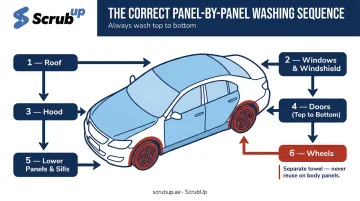
Step 2: Start From the Top, Work Panel by Panel
Follow this sequence without exception:
- Roof
- Windows and windshield
- Hood
- Doors (top to bottom)
- Lower panels and sills
- Wheels last — always last
Wheels carry the heaviest contamination. Towels used on wheels must never touch body panels.
Step 3: Apply Product Generously
For rinseless wash: soak your microfibre towel or mitt thoroughly before contact with the panel. For waterless wash: spray liberally onto the panel surface and onto the towel itself.
More lubrication equals less friction. Under-applying product is the fastest route to paint scratches, so err heavily on the side of too much.
Step 4: Wipe in Straight Lines, Not Circles
Use horizontal, straight-line strokes with light-to-medium pressure. Auto Finesse identifies swirl marks as fine light scratches caused by circular wiping. Linear marks are harder to see and far easier to correct than circular swirl patterns. Let the product and microfibre do the work — no scrubbing needed.
Step 5: Flip or Replace the Towel After Every Panel
A towel is contaminated after one panel. The practical system:
- Fold each towel into quarters — this gives you 8 clean faces per towel
- Use one face per panel, then move to the next clean face
- When all faces are used, set the towel aside and grab a fresh one
- Never put a used towel back on a panel
Step 6: Buff Dry With a Separate Clean Towel
Once a panel is wiped clean, use your dedicated dry buffing towel — not the wash towel — to remove remaining solution residue. Work top to bottom following the same panel sequence. This step reveals the streak-free finish and activates any protective polymers built into the wash formula.
Key Factors That Affect Your Results
Results in hose-free washing come down to four variables. Controlling them consistently separates a safe wash from one that gradually degrades paint.
Contamination Level vs. Method Match
Waterless and rinseless chemistries can only encapsulate a finite amount of dirt. Exceed that threshold and unencapsulated particles remain in contact with the surface during wiping. Assess the car before choosing a method — if it looks heavily soiled, pre-soak or skip DIY entirely.
Product Lubrication Quality
Not all waterless or rinseless products are equal. Cheap formulas with low lubricity provide insufficient slip between towel and paint. Look for:
- Polymer-based or high-lubricity labelling
- pH-balanced or pH-neutral formulation
- Biodegradable surfactant content — preferable in UAE conditions
Towel Condition and Rotation
A microfibre towel that has absorbed dirt from one panel becomes an abrasive tool on the next. Towel management matters more than product choice. Wash microfibre towels in dedicated detergent — never fabric softener, which clogs fibres — between sessions. Degraded microfibre scratches rather than cleans.
Heat and Sun Exposure
UAE coastal and island temperatures regularly reach 37–43°C, with Visit Dubai noting August averages of 35°C. In direct sun, waterless and rinseless solutions can dry within seconds. That leaves hazy residue requiring extra buffing and raises scratch risk. Work in smaller sections than you would in cooler climates, and keep a dry buffing towel immediately ready after each pass.
Common Mistakes to Avoid
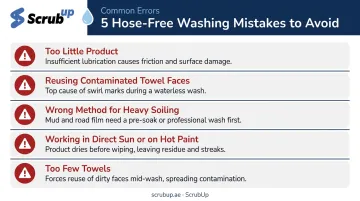
Most waterless wash mistakes come down to shortcuts — and the paint is what pays. Avoid these before you start:
- Using too little product — a light mist instead of a generous coat cuts lubrication drastically; the paint pays the difference
- Reusing contaminated towel faces — the single most common cause of swirl marks; one panel, one clean face, no exceptions
- Applying waterless wash to heavily soiled paint — thick road film, mud, bird droppings, or post-sandstorm dust cannot be safely wiped off with spray chemistry alone; the result is visible scratching
- Working in direct sun or on warm paint — product dries before you can wipe, making even perfect towel technique useless; always work in shade or during cooler hours
- Under-preparing on towels — 3D Products recommends at least 12 microfibre towels per vehicle; running short mid-wash forces you to reuse dirty faces
When DIY Hose-Free Washing Isn't Enough
Hose-free washing handles regular light-to-moderate maintenance well. There are situations where it isn't the right tool.
Consider professional mobile washing when:
- The car has been through a sandstorm or heavy dust event — contamination exceeds what rinseless chemistry can safely handle
- The car hasn't been washed in several weeks and grime has bonded to the surface
- You own a ceramic-coated or luxury vehicle where paint correction is expensive and the margin for error is small
- Your schedule simply doesn't allow for a careful, methodical DIY session
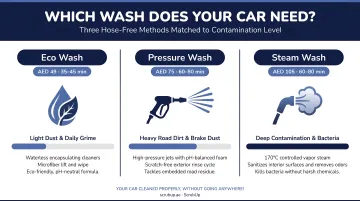
For sandstorm-affected vehicles, ScrubUp's Pressure Wash (AED 75) is the right call. It uses controlled water pressure combined with high-density foam to lift bonded sand and road grime without the aggressive blasting that risks paint or trim damage.
For deep sanitisation after prolonged neglect, the Steam Wash (AED 105) uses controlled vapour at 170°C to reach seams, vents, and interior surfaces that standard washing can't access.
ScrubUp's mobile service comes directly to your parking spot across Dubai — basement parking, gated villas, and office parks across areas like Al Khail, Discovery Gardens, and Dubai Investment Park. No water or power connection is needed from your side, so it works wherever your car is parked. The only exception is RTA-designated parking locations.
If the DIY approach suits your situation but you'd prefer a professional touch, ScrubUp's Eco Wash (AED 49) applies the same encapsulation-based waterless chemistry covered in this guide. It's pH-balanced, biodegradable, and saves an average of 100–150 litres of water per session — with trained technicians handling the microfibre technique.
Conclusion
Washing a car without a hose is entirely practical when the method matches the contamination level, lubrication is generous, and towel rotation is disciplined. Most failures — scratches, streaks, paint dullness — come not from the absence of a hose but from using the wrong method, under-applying product, or wiping with a dirty towel.
Get those three variables right and hose-free washing is consistently reliable for weekly maintenance in Dubai's conditions.
For anything beyond routine upkeep — post-sandstorm cleaning, coated paint, or a car that's been left too long — professional mobile washing offers the safety and control that DIY cannot always provide. ScrubUp's mobile service covers exactly these situations — coming directly to your parking spot across Dubai with professional-grade pressure washers and steam equipment, so you're not choosing between convenience and a proper clean.
Frequently Asked Questions
Can I wash my car without a hose in a covered parking garage?
Waterless and rinseless methods are specifically designed for covered parking with no running water. Good ventilation helps, and working panel by panel keeps the process manageable in a garage space.
What is the difference between a waterless wash and a rinseless wash?
Waterless wash requires no water at all — it's spray-on, wipe-off chemistry only. Rinseless wash dilutes a small amount of concentrate in a bucket of water for a more thorough clean. Rinseless suits moderate dirt; waterless suits light dust only.
Is waterless car washing safe for ceramic-coated or luxury cars?
Yes, provided the product is pH-balanced and coating-safe, and technique is careful. For high-value vehicles, professional mobile washing with verified coating-safe products is the lower-risk option.
How much water is needed for a rinseless wash at home?
A rinseless wash cleans an entire vehicle with roughly 7–8 litres of water. A standard hose wash can use 100–150 litres by comparison, making rinseless a practical choice for apartment residents with no outdoor tap access.
How often should I wash my car using hose-free methods in Dubai?
Once every one to two weeks is a reasonable guide given Dubai's dust levels. More frequent, lighter sessions are safer for paint than infrequent deep cleans where heavy contamination has to be wiped off without rinsing.
Can I use hose-free methods to clean my car's interior at home?
Yes — dashboard, trim, and seat surfaces can be maintained with dedicated spray-on interior cleaners and microfibre cloths. The same waterless principle applies, and no hose or water connection is needed.