Introduction
Cars in Dubai don't age the way they do elsewhere. The combination of fine airborne sand acting as a constant micro-abrasive, UV Index readings that regularly hit the "extreme" classification, and summer temperatures climbing above 40°C creates conditions that attack paint, glass, and interior materials faster than most owners expect.
Most drivers treat washing as something they do when the car looks dirty. The problem with that approach is that the damage doesn't wait for visible signs — contaminants bond to surfaces, oxidation accumulates under the clear coat, and bacteria accumulate in the cabin long before anything obvious appears.
Understanding what's actually happening to your car changes how you think about washing it. This article covers five specific, measurable ways that regular car washing creates lasting value — for your vehicle's condition, its resale price, your passengers' health, your visibility on the road, and your long-term maintenance costs.
Key Takeaways
- Dubai's UV, sand, and heat attack paint within weeks — washing every two weeks is the practical minimum
- A clean exterior preserves resale value; paint damage and interior odour are costly to reverse
- Aston University researchers found up to 1,425 bacteria per sample in average car boots — interior cleaning is a health issue, not a luxury
- A dusty windscreen can double your crash risk — don't underestimate visibility loss
- Regular washing costs far less than a single paint correction or full detailing restoration
What Regular Car Washing Really Means
"Regular" doesn't mean a quick rinse when the car looks visibly dirty. It means consistent cleaning of the exterior, glass, undercarriage, and interior at a frequency that prevents contaminants from bonding to or degrading surfaces.
In Dubai, that baseline is every two weeks for most drivers — ScrubUp recommends this as the minimum to protect paint and maintain cabin hygiene. Some situations call for more frequent washes:
- Open parking with direct sun and dust exposure
- Proximity to industrial zones or active construction sites
- Any significant sandstorm, which warrants an immediate clean regardless of where you are in your schedule
Consistency matters more than intensity — in Dubai's environment, three weeks of neglect can undo what one thorough wash achieves. The five benefits below are only realized when washing becomes a habit, not a reaction.
The 5 Long-Lasting Benefits of Regular Car Washing
Benefit 1: Paint and Exterior Protection
Dubai creates a triple threat for car paint. Fine sand particles act as a micro-abrasive on every surface they contact. UV radiation (classified by the WHO as "Extreme" at Index 11+, a level Dubai regularly reaches in spring and summer) degrades the clear coat through photo-oxidation. Heat accelerates that process further, with temperatures routinely exceeding 40°C.
Published research on automotive coatings found measurable deterioration in clear-coat scratch resistance after just one month of outdoor exposure due to oxidation and hydrolysis. A separate study confirmed that weathered automotive paint shows pitting, cracking, flaking, and peeling under erosion conditions. Both describe what happens to an unprotected car in Dubai's outdoor environment.
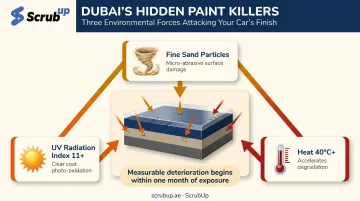
Regular washing interrupts this cycle by removing contaminants before they bond to or etch the surface.
What makes the method matter as much as the frequency:
- pH-balanced, paint-safe foam lifts sand and grime before any contact tool touches the surface
- Controlled pressure removes road film without abrading the clear coat
- Soft microfiber materials prevent the swirl marks and micro-scratches that home washes with wrong cloths or household soap introduce
ScrubUp's Pressure Wash (AED 75) was built specifically for this: high-density foam pre-treatment loosens bonded sand, followed by controlled pressure rinsing that covers body panels, wheels, and undercarriage (the areas where Dubai's sand accumulates most aggressively).
Vehicles parked outdoors, in shared basement lots with poor air circulation, or near construction sites face the highest exposure and benefit most from the full two-week schedule.
Benefit 2: Preserved Resale Value
When a buyer walks up to your car, the paint tells them everything about how the vehicle was cared for. Dull finish, swirl marks, faded sections, or visible oxidation signals neglect — and the asking price drops accordingly.
In Dubai's used-car market, platforms like DubiCars and CarSwitch use exterior condition as a core variable in their pricing algorithms. Paint condition, prior body work, and interior odour all factor into what a car actually sells for — not just what the seller asks.
The practical issue isn't a single bad wash. It's cumulative neglect:
- Sand etching and paint oxidation build gradually over months
- Interior staining and odour from trapped moisture and dust are expensive to reverse professionally
- A car cleaned consistently throughout its life requires far less pre-sale restoration than one that's been cleaned reactively
The economics are straightforward. The cost of regular washing across three years of ownership is a fraction of what paint correction or a professional detailing restoration costs before a sale. A restored car rarely commands the same price as one maintained consistently — the difference shows in the finish, and buyers notice.
Benefit 3: Interior Hygiene and Passenger Health
Car interiors are enclosed environments. Dust, food particles, sweat residue, and fine particulate matter accumulate on every surface (seats, carpets, door panels, air vents) and the cabin's limited airflow creates ideal conditions for bacterial growth.
Research published by Aston University found 1,425 bacteria per sample in average car boots and identified E. coli as likely present in every boot sampled. A peer-reviewed study in BMC Microbiology confirmed pathogenic bacterial communities on frequently touched interior surfaces including steering wheels and gear shifts. In Dubai's humid summer months, the conditions for accelerated growth are even more pronounced.
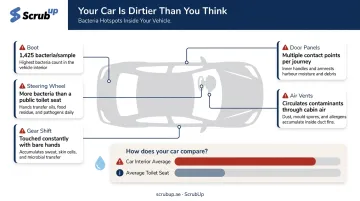
Standard wiping doesn't solve this. It moves bacteria around hard surfaces but leaves fabric, crevices, and air vents largely untreated.
ScrubUp's Steam Wash (AED 105) addresses what a surface wipe cannot:
- 170°C controlled vapour kills bacteria on seats, carpets, door panels, dashboards, touch surfaces, and air vents
- Steam penetrates seams and crevices where bacteria and odours are trapped
- No chemicals involved — heat alone does the sanitisation work, making it safe for children, allergy-sensitive passengers, and pet owners
- Interior vacuuming is included across all three service tiers (Eco Wash, Pressure Wash, and Steam Wash)
For rideshare vehicles, family cars, and any vehicle that regularly carries passengers, interior sanitisation isn't optional — it's part of keeping the vehicle fit for use.
Benefit 4: Safer Driving Through Better Visibility
A dusty windscreen isn't just cosmetic. The Monash University Accident Research Centre found that dirty windscreens caused drivers to crash twice as often in simulator testing and slowed their reaction times compared to clean glass.
In Dubai, this risk has specific local dimensions:
- Fine dust film on glass creates intense glare under direct sun (a dry cloth smears rather than clears it)
- Water spots and sand residue on side mirrors reduce rearview clarity during lane changes
- Rare rain events, when they do occur, turn accumulated grime into streaks that obscure vision precisely when conditions are already difficult
- Fog events prompted Dubai Police to handle 8,263 emergency calls during a single episode in 2019 — reduced visibility is a documented, recurring safety issue here
Regular washing that specifically addresses glass surfaces, door mirrors, and rear windows maintains unobstructed sightlines. Clean glass is functional, not decorative.
Benefit 5: Fuel Efficiency and Long-Term Cost Savings
Beyond visibility and vehicle condition, there's a direct cost argument. A layer of dirt on a vehicle's surface increases aerodynamic drag. Research on road vehicle aerodynamics confirms that drag accounts for nearly 50% of fuel consumption at higher speeds — a clean surface reduces resistance slightly but the effect adds up over high-mileage use.
The more significant savings argument is preventive maintenance:
- Sand and debris that accumulate in wheel arches and undercarriage components accelerate surface corrosion
- Contamination left on paint long enough to etch or oxidise requires professional correction at significantly higher cost than the washes that would have prevented it
- Interior neglect that reaches the point of odour, staining, or mould requires deep restoration detailing
High-mileage drivers and anyone covering significant daily distances in Dubai stand to gain the most measurable fuel and maintenance savings from consistent cleaning. The cost of ScrubUp's Eco Wash starts at AED 49 — a fraction of what even a basic correction session runs.
ScrubUp's Smart Car Care Plans (weekly or monthly subscription) automate this consistency entirely, with auto-renewal and flexible scheduling that removes the friction of remembering to book.
What Happens When Car Washing Gets Skipped
Skipping washes doesn't just delay cleaning — it changes what cleaning can achieve.
Contaminants that sit on paint for days bond to the clear coat. What a wash would have removed in 45 minutes requires abrasive correction work. Sand that etch-marks the surface in heat can dull paint permanently, particularly on dark-coloured vehicles parked outdoors. Interior bacteria and odour that are routine to prevent become expensive to reverse once embedded in fabric.
The compounding effect is the problem:
- Weeks 1–2: Dust and sand sit on the surface, removable with a standard wash
- Weeks 3–4: Fine particles begin bonding under heat; gloss starts to dull
- Months 2–3: Oxidation becomes visible; glass water spots harden; interior odour develops
- Beyond that: Restoring the finish requires significant time, money, and specialist intervention
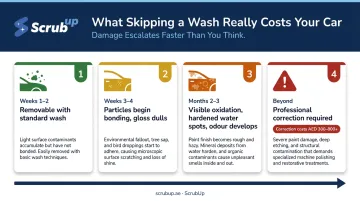
Every skipped wash moves the vehicle from preventive care into corrective territory. That shift is far more expensive to undo than it was to avoid.
How to Make Regular Car Washing a Consistent Habit in Dubai
The biggest barrier to regular washing in Dubai isn't awareness — it's logistics. Most residential buildings have no outdoor washing space, basement parking rules out the hose-and-bucket approach entirely, and busy schedules mean the car gets washed when it's convenient, not when it's due.
That's the gap ScrubUp fills. The service comes directly to your parking spot — whether that's a basement, outdoor lot, gated community, or office building — so there's no driving, no queuing, and no schedule reshuffling required.
Practical steps for building consistency:
- Set a two-week reminder in your calendar — treat it like a scheduled service, not a reactive chore
- Book after obvious triggers: any sandstorm, long highway drive, or rain event warrants an immediate wash
- Use a subscription plan — ScrubUp's weekly and monthly Smart Car Care Plans auto-renew and handle scheduling for you, so you never have to think about it
- Match the tier to conditions: Eco Wash (AED 49) for routine upkeep, Pressure Wash (AED 75) after heavy dust or sand, Steam Wash (AED 105) quarterly for interior hygiene
Booking takes under a minute — via the ScrubUp app, book.scrubup.ae, or WhatsApp — and same-day slots are often available.
Frequently Asked Questions
Is it good to wash your car every day?
Daily washing is unnecessary for most drivers and will gradually wear down protective wax coatings over time. For Dubai conditions, every two weeks is the recommended baseline — daily washing provides no additional protection and may do more harm than good to wax and sealant layers.
How often should you wash your car in Dubai?
Bi-weekly washing is the practical minimum given Dubai's desert dust, UV intensity, and periodic sandstorms. After a significant dust event or long highway drive through open terrain, an additional wash is advisable regardless of where you are in your regular schedule.
Does washing your car protect the paint?
Yes. Removing sand, UV-accelerated oxidation residue, and contaminants before they bond to the clear coat is the primary protective function of washing. Product choice matters too — harsh soaps and incorrect techniques cause micro-scratches that accumulate and dull the finish over time.
What happens if you don't wash your car regularly?
Paint fades, clear coats oxidise, water spots harden on glass, and interior bacteria build up — each problem getting harder to reverse the longer it's ignored. What regular washing prevents, professional detailing or a full respray is required to fix.
Can a dirty car affect fuel efficiency?
Accumulated dirt increases aerodynamic drag, forcing the engine to work harder at speed. The fuel impact is modest per trip but adds up over high mileage — though the stronger argument for regular washing is maintenance cost, not fuel savings.
What are the benefits of washing your car regularly?
Regular washing protects paint, preserves resale value, improves interior hygiene, maintains driving visibility, and supports fuel efficiency. In Dubai's environment specifically, the cost of neglect significantly outweighs the cost of routine maintenance.