Generic car care advice doesn't account for this. Guidance written for temperate climates will leave Dubai drivers underprepared, reacting to breakdowns rather than preventing them. The ten tips below are built specifically around what Dubai's roads actually demand.
Key Takeaways
- Dubai's heat breaks down engine oil, degrades batteries, and stresses cooling systems faster than in moderate climates
- Tire pressure fluctuates significantly with temperature — check it cold, twice a month
- Skipping AC maintenance in Dubai isn't just uncomfortable — it's a real reliability risk
- Sand, UV radiation, and humidity degrade paint year-round without regular washing
- Dubai's climate demands shorter service intervals than most manufacturers set for temperate conditions
Why Dubai's Climate Makes Car Maintenance Non-Negotiable
Most maintenance schedules are designed for drivers in moderate climates. Dubai doesn't qualify.
WeatherSpark data shows Dubai temperatures typically ranging from 14°C to 41°C, rarely dropping below 11°C, with summers that are relentlessly hot and dry. A UAE cool-pavement study recorded pavement surface temperatures hitting 60°C in summer — meaning the microclimate your tires, rubber seals, and underbody components operate in is far hotter than ambient air temperature suggests.
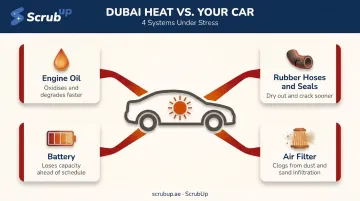
This persistent heat accelerates wear across nearly every vehicle system:
- Engine oil oxidises and degrades faster
- Rubber hoses and seals dry out and crack sooner
- Batteries lose capacity well ahead of schedule
- Air filters clog from continuous dust and sand infiltration
These aren't edge cases — they're daily realities here. Manufacturers including Nissan, Toyota, and Ford all list "stop-and-go traffic in hot weather" and "dusty conditions" as triggers for their severe-service maintenance schedules, and every one of those conditions applies to Dubai drivers year-round.
Following a proactive maintenance routine in this environment is a financial decision as much as a mechanical one. Catching a deteriorating coolant hose before it fails costs a fraction of what an overheated engine repair does.
Tips 1–5: Engine, Fluids, Battery, and AC
Tip 1 — Engine Oil
Dubai's heat causes conventional motor oil to oxidise, thicken, and leave deposits faster than in cooler conditions. When you add stop-and-go city traffic — which keeps engines running hot without the cooling airflow of highway driving — oil stress increases even if your annual mileage is modest.
Most manufacturer severe-service schedules recommend oil changes around every 5,000 km under these conditions. Don't rely solely on the standard interval; check your owner's manual for the severe-service schedule specifically.
Signs to act before your scheduled interval:
- Oil appears dark or gritty on the dipstick
- Engine sounds noisier than usual at startup
- Oil level has dropped noticeably between checks
Synthetic oil handles heat stress better than conventional oil and is worth the modest price difference in Dubai's climate.
Tip 2 — Coolant and Cooling System
The cooling system is your engine's primary defence against heat — and in Dubai, it works harder than almost anywhere else. AAA's overheating guidance identifies coolant system failures — thermostat, radiator, water pump — as the leading cause of engine overheating.
Check coolant levels monthly and inspect the full system before peak summer. Watch for these warning signs:
- Coolant appears dirty, rust-coloured, or smells burnt
- Level drops repeatedly between checks (indicates a leak)
- Puddles under the parked car
- Temperature gauge running higher than normal
Modern coolants typically last 5 years or 50,000 miles, but Dubai's conditions warrant checking quality annually regardless.
Tip 3 — Air Filter Replacement
Dubai's sand and dust clog air filters significantly faster than the standard 15,000–30,000 km replacement intervals assume. Both Ford and Toyota explicitly note that dusty and desert conditions shorten filter life — and Dubai qualifies on both counts.
Check engine and cabin air filters every 3–6 months rather than annually. A restricted air filter won't necessarily hurt fuel economy in modern fuel-injected vehicles, but it can reduce engine responsiveness and allow fine particulate matter into the engine or cabin.
It's also one of the most affordable fixes: filters typically cost under AED 100 and can often be swapped out without tools.
Tip 4 — Battery Maintenance
Heat is harder on car batteries than cold weather, and the data supports this clearly. According to AAA, batteries may last five years or more in cooler northern climates, but in hot regions they typically last about three years — a finding Consumer Reports also confirms.
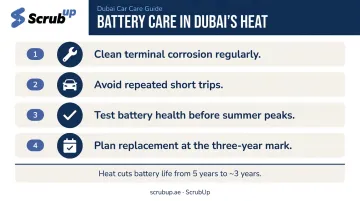
For Dubai drivers, practical battery advice:
- Clean terminal corrosion regularly — white or blue residue around terminals increases resistance and accelerates failure
- Avoid repeated short trips that don't allow the battery to fully recharge
- Have battery health tested proactively before summer peaks, not after the first no-start
- Plan for replacement around the three-year mark rather than waiting for failure
Tip 5 — AC System Servicing
In Dubai, a functioning AC is a safety requirement. Driving through summer without it isn't just uncomfortable — it's genuinely dangerous.
Dubai's Roads and Transport Authority (RTA) includes AC efficiency checks in its official summer vehicle safety guidance, alongside tyres, coolant, and battery condition. Have the system inspected before peak summer heat arrives, covering:
- Refrigerant level and integrity
- Cabin air filter condition
- Compressor and condenser performance
- Any unusual noises or reduced cooling output
Preventive checks catch weak cooling, leaks, and clogged filters early. A pre-summer inspection typically costs a fraction of what a full compressor replacement runs.
Quick Tip — Understand Your Dashboard Warning Lights
Many Dubai drivers ignore warning lights or assume they can wait until the next service. Some can't. Here are the five you should never dismiss:
| Warning Light | What It Means | What To Do |
|---|---|---|
| Check Engine | Engine or emissions issue detected | Diagnose immediately — causes range from minor to serious |
| Oil Pressure | Oil pressure critically low | Stop driving as soon as safely possible |
| Coolant Temperature | Engine overheating | Pull over, let engine cool — do not open the radiator cap |
| Tyre Pressure (TPMS) | One or more tyres under-inflated | Check all four tyres when cold before driving further |
| Battery | Charging system fault | Get to a workshop — the battery or alternator may be failing |
Tips 6–10: Tyres, Brakes, Exterior, Interior, and Washing
Tip 6 — Tyre Pressure and Rotation
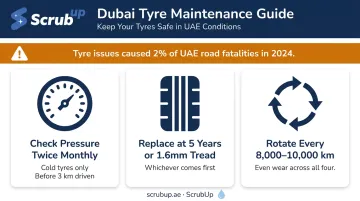
RoadSafetyUAE reports that tyre-related accidents caused 2% of UAE road fatalities in 2024 — seven deaths. This is a safety issue, not just a maintenance one.
Dubai's heat causes tyre pressure to rise and fluctuate significantly. Bridgestone data shows pressure changes by approximately 1 PSI for every 10°F change in ambient temperature — meaning tyres inflated correctly in the morning can be over-inflated by afternoon and back down by the next cool morning.
Key tyre maintenance actions:
- Check pressure at least twice a month, when tyres are cold (driven less than 3 km)
- Replace tyres no later than 5 years old or when tread depth falls below 1.6 mm
- Rotate tyres every 8,000–10,000 km for even wear across all four
Tip 7 — Brake Inspection
Dubai's driving pattern — high-speed highways combined with heavily congested city roads — creates above-average brake wear. Urban stop-and-go driving generates substantially more brake stress than steady highway cruising, and the combination puts pads and rotors through accelerated wear cycles.
Listen and watch for these warning signs:
- Squealing or grinding when braking — pads are worn or rotors damaged
- Longer stopping distances than you'd expect
- Vibration through the pedal when braking at speed
- Pulling to one side during braking
Have brake pads and rotors inspected at every service interval. Delaying brake maintenance rarely saves money — worn pads that damage rotors turn an AED 150 pad replacement into a far more expensive rotor job.
Tip 8 — Exterior Protection from UV and Sand
Dubai's July UV index averages 9 (Very High) according to Weather Atlas — enough to fade paint and degrade clear coat over months, not years. Simultaneously, airborne sand acts as a continuous fine abrasive, creating micro-scratches and dulling the finish with every windstorm.
Practical exterior protection steps:
- Park in shade or use a car cover whenever the vehicle sits outdoors for extended periods
- Apply protective wax or paint sealant periodically to maintain the clear coat barrier
- Address paint chips promptly — exposed bare metal invites moisture and rust, especially in Dubai's coastal humidity
- Wash regularly to remove abrasive particles before they work into the paint surface
Tip 9 — Interior Sanitisation
Dubai's heat turns a neglected car cabin into an environment where bacteria, mould, and persistent odours build fast. Research published in Air Quality, Atmosphere & Health found measurable microbial contamination in passenger car AC systems, with a follow-up study confirming that AC filters can become active sources of in-car biological exposure.
Frequent AC use combined with heat, dust, and humidity accelerates this buildup in Dubai's conditions specifically.
Interior maintenance priorities:
- Replace cabin air filters every 3–6 months — they trap dust, pollen, and particulate matter but become ineffective when saturated
- Steam clean the interior periodically to sanitise upholstery, surfaces, and vent areas
- Don't ignore persistent odours — they often indicate bacterial or mould growth, not just a stale smell
ScrubUp's Steam Wash service uses controlled 170°C vapour to sanitise interior surfaces, including trims and hard-to-reach areas, without harsh chemicals — which matters for repeated treatments on sensitive upholstery and dashboard materials.
Tip 10 — Regular Car Washing
Washing the car is not purely cosmetic in Dubai. Sand and dust carry mineral particles that degrade paint. Coastal humidity introduces salt that accelerates corrosion on exposed metal. Prolonged UV exposure on dirty surfaces breaks down clear coat faster than on clean ones. Nissan's own owner's manual instructs drivers to wash "as soon as possible after driving on coastal roads and when contaminants contact the paint."
Wash your car every 1–2 weeks in Dubai's conditions. For busy residents who can't make regular trips to a wash station, ScrubUp's mobile car wash service removes that barrier entirely — booking via the ScrubUp app, website at book.scrubup.ae, or WhatsApp, with the team arriving fully equipped at your parking spot.
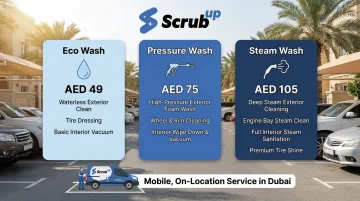
Three service tiers cover different needs:
- Eco Wash (AED 49) — Waterless cleaning using encapsulating compounds that lift sand particles safely from the paint surface without abrasion
- Pressure Wash (AED 75) — High-pressure foam and water for heavier road grime and sand buildup, with tyre and rim cleaning
- Steam Wash (AED 105) — 170°C vapour for deep exterior and interior sanitisation, particularly suited to Dubai's dusty, high-heat conditions
Book once, and ScrubUp handles everything at your parking spot — no queues, no trip across town.
Bonus — Follow a Dubai-Specific Maintenance Schedule
Standard manufacturer intervals are designed for moderate climates. Dubai driving typically qualifies as severe service under most OEM definitions, which means shorter intervals apply. Use this as a reference framework and verify specific items with your model's severe-service schedule:
| Frequency | What to Check |
|---|---|
| Monthly | Tyre pressure (cold), all fluid levels, visual inspection for leaks or damage |
| Every 5,000 km | Engine oil and filter condition, check against severe-service schedule |
| Every 10,000 km | Full service: spark plugs, all filters, brake inspection, fluid top-ups |
| Every 6 months | AC system, cabin air filter, cooling system and hoses |
| Annually | Comprehensive brake, electrical, and suspension inspection; battery health test |
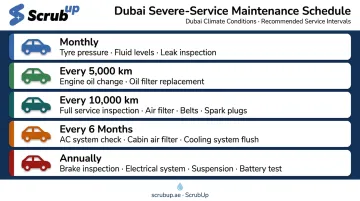
These intervals run shorter than global defaults. That's intentional. Catching wear early in Dubai's climate costs a fraction of what reactive repairs do.
Conclusion
Dubai's climate doesn't leave much room for a relaxed approach to car maintenance. The heat, sand, UV exposure, and stop-and-go traffic combine to wear vehicles down faster than most drivers expect, and faster than most standard maintenance schedules are built for. A more frequent, proactive routine keeps repair costs down, extends vehicle life, and keeps occupants safer on roads where vehicle condition is actively enforced.
That routine includes the exterior. ScrubUp handles that part by coming directly to your location — whether you're at home, at the office, or parked in a residential community — with paint-safe techniques designed for Dubai's conditions, no queues, and no wasted trips. Book via the app, at book.scrubup.ae, or on WhatsApp.
Frequently Asked Questions
What are important maintenance tips for a car?
The core checklist covers regular oil changes, tyre pressure monitoring, fluid levels, brake inspections, battery testing, and air filter replacement. Dubai's extreme heat, dust, and stop-and-go traffic accelerate wear on all of these — follow your vehicle's severe-service schedule, not the standard one.
What is the 30-60-90 maintenance schedule?
The 30-60-90 schedule covers service milestones at 30,000, 60,000, and 90,000 km: filters and fluids at 30k, spark plugs and drive belts at 60k, and major component inspections at 90k. In Dubai, accelerated wear means these milestones can arrive sooner — use the severe-service intervals in your owner's manual.
How often should I service my car in Dubai's climate?
Every 7,500–10,000 km or every 6 months, whichever comes first. Dubai's heat and dust degrade components faster than the standard intervals most manufacturers design for moderate driving conditions — following the severe-service schedule in your owner's manual is the safest approach.
Does Dubai's heat affect my car battery life?
Yes, significantly. According to AAA, batteries in hot climates typically last around three years, compared to five or more years in cooler regions. Have battery health tested annually and replace proactively around the three-year mark — don't wait for a no-start in 45°C heat to find out it's failing.
How do I protect my car's paint from sand and UV damage in Dubai?
Four habits make a real difference:
- Wash regularly to remove abrasive sand before it works into the clear coat
- Park in shade or use a car cover during extended outdoor exposure
- Apply protective wax or paint sealant periodically
- Address paint chips promptly to prevent corrosion on bare metal
Should I wash my car more frequently in Dubai?
Every 1–2 weeks is advisable given Dubai's combination of sand, dust, humidity, and UV exposure — all of which degrade paint and exposed surfaces faster than in moderate climates. Mobile car wash services like ScrubUp make this routine manageable for busy residents without adding another errand to the day.