Neglected mats don't just look bad. They become breeding grounds for bacteria and mold, produce persistent odors, and — when damage reaches the underlying carpet — create repair costs that directly affect your car's resale value. MANN-FILTER reported in 2024 that every third vehicle interior is contaminated with bacteria, mold, particulate matter, pollen, or harmful gases.
This guide covers mat types, the right cleaning method for each, how to handle stubborn stains and odors, and a maintenance schedule suited to Dubai's conditions.
Key Takeaways
- Rubber and carpeted mats need different cleaning approaches — the wrong method damages both mat and floor
- Dubai's dust and heat make monthly cleaning the minimum — not quarterly
- Never reinstall mats before they've dried fully — damp mats in a hot car cause mold within 24–48 hours
- Steam cleaning lifts embedded grime from carpeted mats without soaking the fibers — the most effective deep-clean method available
- Curled, cracked, or poorly fitting mats are a safety hazard, not just a cosmetic issue
Why Your Car Floor Mats Deserve More Attention Than They Get
Floor mats exist to protect the car's fixed interior carpet from the daily buildup of sand, moisture, and spills. That protection matters because damage to the underlying carpet is expensive — often irreversible — and visible interior wear factors directly into resale valuations on platforms like DubiCars and Carzoo.
The Hygiene Problem Is Real
Car interiors are dirtier than most people assume. A 2014 study published in Biofouling found that Staphylococcus and Propionibacterium were the dominant bacterial genera found in sampled car interiors. In Dubai's summer heat, a mat that stays damp — even briefly — becomes a fast-accelerating environment for microbial growth and odor.
Why Dubai's Dust Is a Different Problem
Fine desert sand doesn't just sit on top of carpet fibers. Under foot traffic, it works down into the pile and acts as an abrasive, cutting fibers with every step. The air quality data puts that in perspective:
- PM10 levels near Dubai and Abu Dhabi airports reach up to 750 µg/m³ during mild dust storms
- On an ordinary day, PM10 still sits between 100–250 µg/m³
- That's the particulate your mats intercept before it reaches the carpet pile beneath
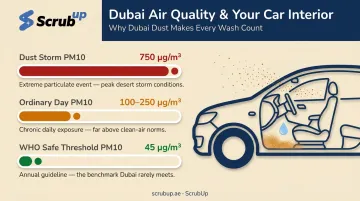
Each gram of sand trapped in your mats is one that's not grinding into the fixed carpet underneath. The more you let it accumulate, the faster both layers wear out.
Know Your Mats: Types and What They Need
Most Dubai drivers use one of two types:
- Rubber/all-weather mats — common in SUVs, work vehicles, and practical daily drivers
- Carpeted mats — common in sedans and luxury cars
The mat type determines everything about how you clean it. Using a carpet shampoo on rubber mats wastes product. Hosing down carpeted mats without proper drying creates a mold problem.
Rubber and All-Weather Mats
Rubber and thermoplastic elastomer (TPE) mats are built for Dubai's conditions. They're water-resistant, easy to hose down, and designed with raised channels that trap sand, mud, and water before it reaches the carpet below.
The cleaning process is straightforward, though those grooves are where fine desert sand packs tight and won't shake out without focused scrubbing. Avoid bleach, harsh solvents, and petroleum-based cleaners; they degrade rubber over time and cause cracking. Mild soap or a gentle automotive detergent, as recommended by manufacturers like WeatherTech and Husky Liners, handles Dubai's everyday dirt without issue.
Carpeted Mats
Carpeted mats are softer and more premium in feel, but the trade-off is porosity. They absorb odors, spills, and bacteria far more readily than rubber. They also require much longer drying time — in Dubai's summer, improperly dried carpet mats can develop mold within hours.
These mats need shampooing or steam cleaning rather than a hose-down. The drying step cannot be skipped or rushed.
Step-by-Step: How to Clean Your Car Floor Mats
One rule applies to both mat types before anything else: always remove the mats from the vehicle before cleaning. Cleaning them in place means dirty water soaks into the underlying carpet — the exact thing you're trying to protect.
Cleaning Rubber Mats
- Remove and shake — Bang the mat firmly against a hard surface to dislodge sand and gravel from the grooves
- Rinse — Use a hose or pressure washer to clear loose surface dirt
- Scrub — Apply mild soap and work a stiff brush through the textured channels; this is where Dubai sand packs densest
- Rinse thoroughly — Make sure no soap residue remains in the grooves
- Dry upright in shade — Stand mats on edge away from direct sunlight; prolonged UV exposure degrades rubber over time
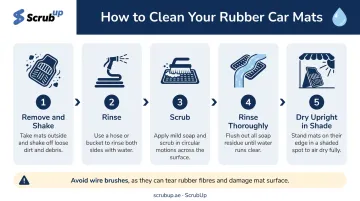
Avoid wire brushes or abrasive scrubbers, which scratch the surface and accelerate wear.
Cleaning Carpeted Mats
- Vacuum both sides — Use a crevice tool to pull embedded sand from the fibers before any moisture is introduced
- Apply carpet cleaner — Use a foam upholstery shampoo or automotive carpet cleaner; let it dwell per the product instructions
- Scrub gently — Use a medium-bristle brush in short overlapping strokes; don't scrub aggressively or you'll push dirt deeper
- Extract moisture — Blot with clean microfibre cloths or use a wet-dry vacuum to pull out as much water as possible
- Dry for a minimum of 24 hours — The EPA and CDC both identify 24–48 hours as the window within which wet materials must dry to prevent mold growth
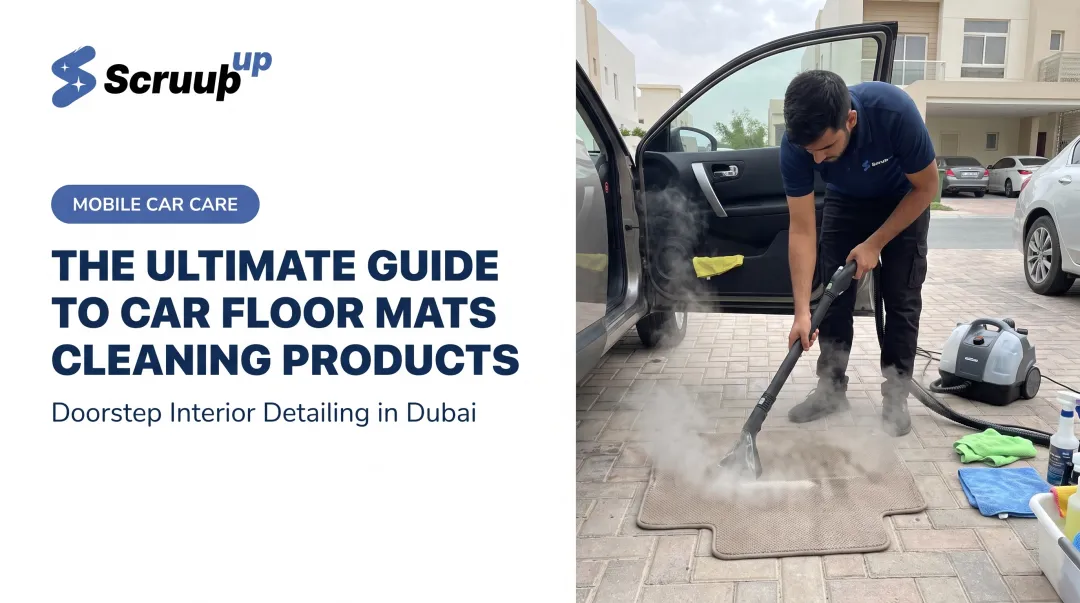
Steam cleaning is the most effective method for carpeted mats in Dubai's conditions. Research shows steam vapor achieved over 90% reduction of mold spores on moist carpet after just 12 seconds of contact, with domestic steam cleaning also eliminating live dust mites and reducing allergens by 86.7%.
It penetrates fibers, kills bacteria, and eliminates odors without soaking the mat — which matters when you need mats dry and back in the car within a day.
If the 24-hour drying window or deep scrubbing feels like more effort than the job warrants, a professional service handles it more efficiently. ScrubUp's Steam Wash (AED 105) uses high-temperature steam with pH-neutral, biodegradable products, and covers mats as part of the standard interior scope — not as an add-on. It includes vacuuming, interior treatment of seats and mats, and a microfibre wipe-down to minimise residual moisture.
Tackling Stubborn Stains and Odors
Regular cleaning handles routine buildup, but some stains and odors need a more targeted approach.
Common Problem Stains
| Stain Type | Treatment Approach |
|---|---|
| Grease/oil | Diluted degreaser or dish soap; apply, dwell, scrub, rinse — avoid acetone on rubber or carpet |
| Sand-mud residue | Let dry completely first, vacuum loose material, then apply cleaner — wet mud embeds deeper |
| Food/beverage spills | Treat immediately with mild cleaner; blot, don't rub; for old stains, use an enzymatic cleaner pre-soak |
Enzymatic cleaners break down organic material at a molecular level rather than just lifting surface residue. For food spills, sweat, and biological odors, they outperform standard carpet cleaners.
Dealing With Persistent Odors
- Light odors: Sprinkle baking soda generously, leave overnight (or at least 15 minutes for minor cases), then vacuum thoroughly.
- Bacteria-based or persistent smells: Use an enzymatic or antifungal cleaner that breaks down the odor source rather than masking it
- Mold or mildew: Treat with diluted white vinegar or an antifungal carpet cleaner; ensure complete drying before reinstallation
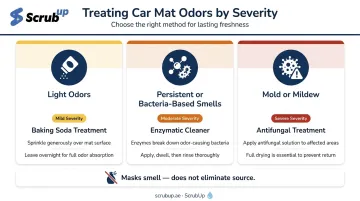
Using air fresheners without treating the source is a common mistake. They mask the smell temporarily while the underlying problem — usually bacteria or mold — keeps developing.
Signs Your Mats Need Cleaning — Or Replacing
Cleaning Triggers
Clean your mats immediately when you notice any of these:
- Visible staining or discoloration
- Noticeable odor when entering the vehicle
- Visible sand or debris packed into grooves or fibers
- Mats feel stiff, sticky, or gritty underfoot
When to Replace Rather Than Clean
Some mat issues can't be cleaned away. Replace your mats when:
- Rubber is cracked, warped, or no longer sits flat — a curled or shifted mat can catch on pedals, which is a recognized road safety hazard
- Carpet fibers are permanently flattened, frayed, or discolored even after deep cleaning
- Persistent odors remain after multiple thorough cleaning attempts
- Mats no longer fit their position properly — any movement toward the pedals is a safety issue
Car Floor Mat Cleaning Schedule for Dubai
The standard advice of cleaning floor mats every 3–6 months was written for temperate climates. Dubai's dust load and heat demand a different approach.
| Frequency | Task |
|---|---|
| After every dust storm or rain | Shake out and quick vacuum |
| Weekly | Quick shake or vacuum pass (especially for daily commuters) |
| Monthly | Full rubber mat wash (hose, scrub, dry) or carpeted mat vacuum + spot treatment |
| Every 2–3 months | Deep clean for carpeted mats (shampoo or steam); check mat condition and fit |
| Annually | Assess replacement need; rotate front and rear mats if symmetrical |
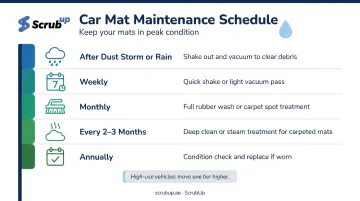
High-use vehicles — family cars, vehicles with pets, or cars where food is regularly eaten — should move one tier higher across the board.
If keeping up with this schedule is a challenge, a mobile interior cleaning service handles it without any trip to a car wash. ScrubUp's Steam Wash (AED 105) includes mat treatment as part of a full interior clean, delivered directly to your parking spot at home, at the office, or in your building's basement. Book in under a minute via the ScrubUp app or WhatsApp, with same-day slots regularly available.
Conclusion
Floor mats are a small component with an outsized effect on interior hygiene, air quality, and vehicle value. In Dubai, fine desert dust settles daily and summer heat turns mild neglect into a genuine mold risk — so consistent care matters more here than most places.
The core principles are straightforward:
- Match your cleaning method to your mat type (rubber, carpet, or all-weather)
- Never reinstall a damp mat — trapped moisture is the fastest route to mold
- Treat odors and stains at the source rather than masking them
A quick weekly shake and a thorough monthly clean will prevent the buildup that makes deep cleaning feel like a chore every time.
For busy Dubai residents, ScrubUp's mobile Steam Wash service takes care of the deep clean at your doorstep when the schedule gets tight — no queues, no driving anywhere.
Frequently Asked Questions
How often should I clean my car floor mats?
In Dubai, a monthly full clean (wash for rubber mats, vacuum and spot-treat for carpeted) is the practical baseline. Weekly shaking or vacuuming keeps sand from embedding between cleans. After dust storms or rain, shake them out immediately rather than waiting for your scheduled clean.
Can I use a steam cleaner on car floor mats?
Steam cleaning is highly effective for carpeted mats — it penetrates fibers, kills mold spores and dust mites, and eliminates odors without saturating the mat. Rubber mats don't need steam; a hose and scrub does the job. After steam treatment, allow carpeted mats to air dry fully before putting them back in the car.
How do I remove sand from carpet car mats?
If the sand is damp, let it dry completely first — wet sand compacts deeper into the fibers when vacuumed or brushed. Once dry, use a stiff brush to break up compacted particles, then vacuum thoroughly using a crevice tool to pull sand out from the base of the fibers.
How do I get rid of bad smells from my car mats?
For light odors, apply baking soda generously, leave it overnight, then vacuum. For persistent smells caused by bacteria or moisture, an enzymatic cleaner that breaks down the organic source is more effective. Don't reach for an air freshener — it masks the smell without eliminating the source.
When should I replace my car floor mats instead of cleaning them?
Time to replace rather than clean when you notice:
- Rubber cracking, warping, or stiffening
- Carpet fibers permanently flattened or discoloured after deep cleaning
- Odors that return after multiple cleaning attempts
- Mats that no longer lie flat and secure in position
A mat that shifts toward the pedals is a safety hazard — replace it immediately.
Can I put rubber car mats in a washing machine?
Avoid it. Machine washing can warp rubber mats and cause them to lose their shape. The hose-and-scrub method — remove, rinse, scrub with mild soap, rinse again, dry upright — gets the same result without any risk of damage.