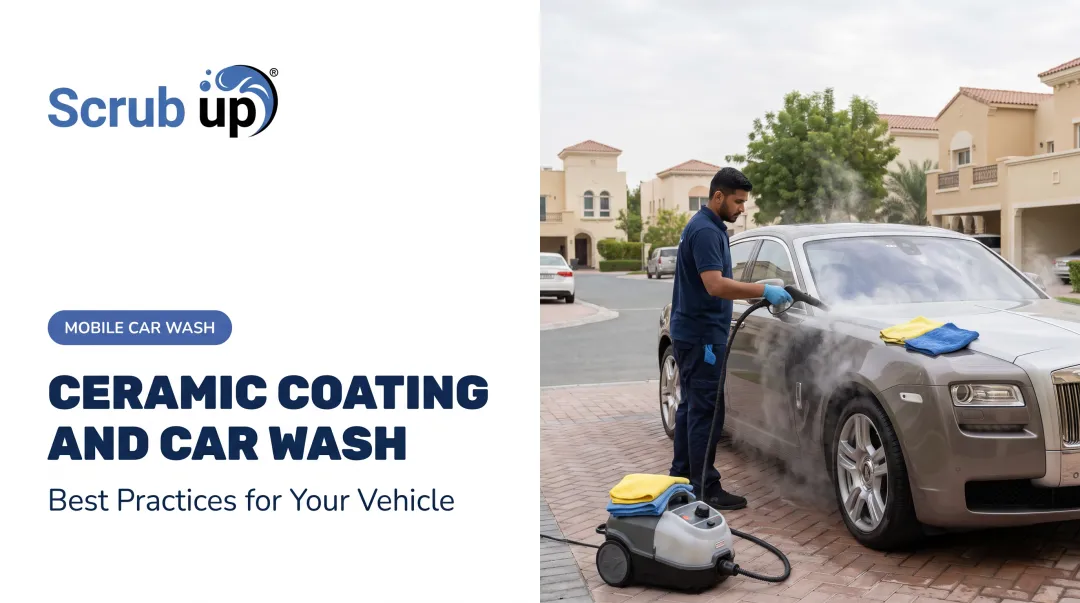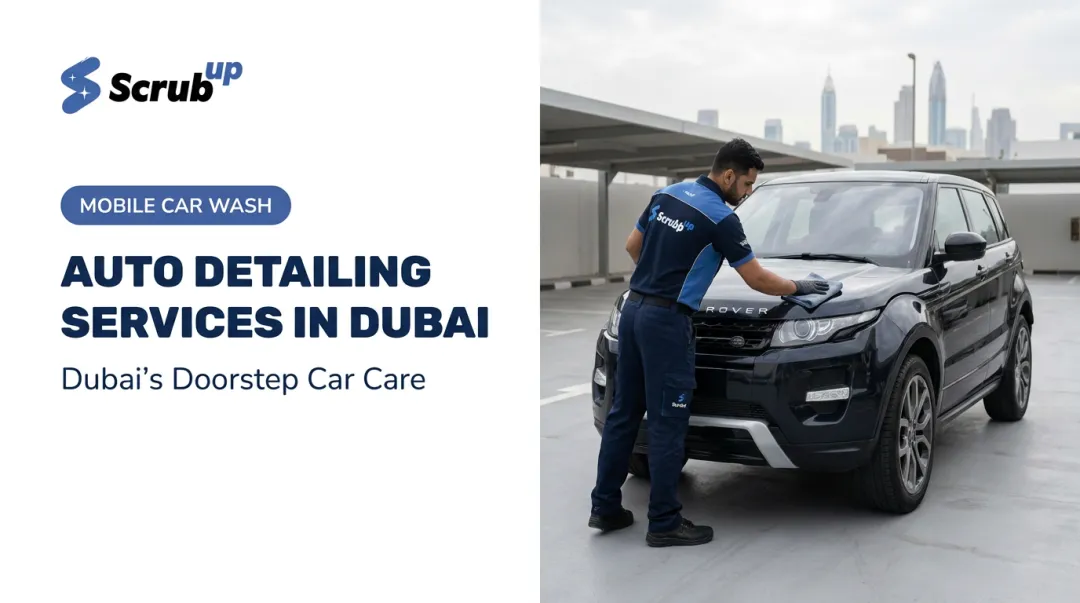
The physics aren't kind here. According to Atlas Material Testing Solutions, black car surfaces in desert conditions regularly reach 70–75°C, with extreme days pushing dark coatings to 90°C. Dubai's summer air temperatures average around 41°C in August — the hottest month — which means panel temperatures on a parked car are often far higher than the thermometer suggests.
On top of the heat, there are legal considerations. Public car washing is prohibited under Dubai municipal law, and dust levels here far exceed what drivers in most other cities deal with. Standard washing habits — built for cooler, less abrasive environments — need adjusting.
This guide covers the right timing, locations, techniques, and products for washing your car safely in Dubai's summer, plus the most common mistakes that cause unintentional paint damage.
Key Takeaways
- Washing a hot car in direct sun causes soap and water to evaporate mid-rinse, leaving permanent water spots and paint etching.
- Wash before 9 AM or after 6 PM, always in shade — never under direct midday sun.
- Use pH-balanced, automotive-specific products only; dish soap and household cleaners strip protective coatings.
- Work top-to-bottom, then dry immediately with microfiber — air drying in Dubai's heat guarantees spots.
- Public car washing is illegal in Dubai and carries fines under Local Order No. 11 of 2003.
Why Dubai's Heat Makes Car Washing More Challenging
The Surface Temperature Problem
When a car sits in Dubai's summer sun, its metal panels reach temperatures that alter how wash products behave entirely. At 70–90°C surface temperatures, water flash-evaporates before you can rinse it. Soap doesn't get the chance to emulsify and lift dirt; it bakes onto the clear coat instead, leaving residue that's harder to remove than the original grime.
Mineral deposits follow the same logic. Dubai's tap water contains dissolved calcium and magnesium. Under normal conditions, thorough rinsing removes these minerals before they dry. On a hot panel, the window for rinsing closes fast — and what's left behind forms white calcium spots that etch into the clear coat over time.
The Sand and Dust Factor
Desert dust in the UAE isn't the same as urban road grime. Research published in Aerosol and Air Quality Research found annual mean PM10 concentrations in the UAE of 122–153 µg/m³ — compared to Mediterranean city averages of 25–52 µg/m³. These fine particles contain silica and other abrasive minerals that scratch paint when rubbed dry.
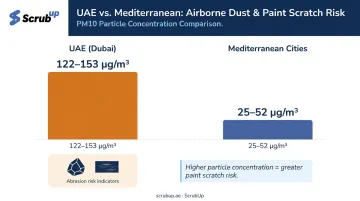
The UK Met Office warned that dry-wiping dust with a cloth or brush causes visible scratches — the particles are abrasive enough without any additional pressure. In Dubai, that risk shows up every morning.
Safe dust removal requires:
- Rinsing or misting the surface first to suspend particles before contact
- Using a clean microfiber cloth (never a dry rag or brush)
- Working panel by panel rather than wiping across the full car in one pass
UV Oxidation and Interior Wear
Dubai's summer UV index regularly hits 11–12, classified as Extreme by WHO standards. Automotive clearcoat contains UV-absorbing compounds that degrade with prolonged exposure — a chemically stripped or compromised paint surface absorbs more radiation, accelerating oxidation and colour fade.
The interior takes its own punishment. Dashboards, leather, and plastic trims expand and contract with daily temperature swings. Dust that settles on hot surfaces grinds into materials when disturbed, turning routine cleaning into a source of damage. Keeping interiors clean reduces this abrasion and slows premature cracking and fading.
Best Practices for Washing Your Car in Dubai's Hot Weather
These aren't generic car care tips — they're adapted for the specific combination of heat, sand, and UV exposure that Dubai's summer delivers.
Choose the Right Time of Day
The two safe washing windows are before 9 AM and after 6 PM. During these hours, panel temperatures drop enough for products to work properly rather than evaporate on contact. DEWA identifies 12 PM–5 PM as peak summer heat, and this aligns with the period when washing risk is highest.
Avoid washing in the middle of the day even in shade — ambient air temperatures alone can cause products to dry too quickly during summer peak hours.
Wash in a Shaded or Covered Location
A covered parking bay, basement, or indoor space does more than protect you from the sun — it keeps the car's metal surface cool enough for the wash process to work. Direct sunlight on a freshly soaped panel during any part of the wash will undo the benefit of good timing.
This is one reason mobile wash services like ScrubUp have a practical advantage here. Technicians work in basement parking, gated community bays, and covered spots — locations where the car is already shaded — bringing all equipment including water supply directly to where the vehicle sits. No customer setup required.
Follow the Correct Wash Sequence
Order matters. A proper Dubai wash sequence:
- Wheels first — remove brake dust and abrasive sand from tyres and rims before touching the bodywork
- Pre-rinse the entire car — loosen and lift surface dust with water before any soap is applied
- Two-bucket method — one bucket for soapy water, one for rinsing the mitt; this prevents transferring sand back onto the paint between panels
- Wash from roof downward — work from the cleanest panel to the dirtiest, keeping grit away from already-cleaned surfaces
- Rinse thoroughly from top to bottom
- Dry immediately
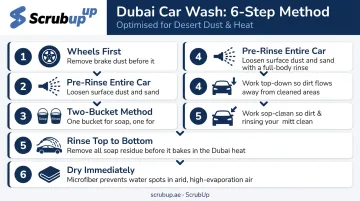
Chemical Guys describes this scratch-free method as the standard for preventing swirl marks, and it's especially important in Dubai where every mitt pass can carry abrasive particles if the two-bucket habit breaks down.
Dry Immediately — Never Air Dry
Air drying in Dubai produces water spots. The combination of high mineral content in tap water and rapid evaporation leaves calcium deposits on paint and glass within seconds of rinsing.
The right drying approach depends on your vehicle:
- Standard cars: Use a clean, high-GSM microfiber drying towel the moment rinsing is complete
- Larger vehicles or complex panel shapes: Run a handheld car dryer or leaf blower over mirrors, grilles, and trim gaps first — this clears pooled water that towels miss and prevents ring marks
- All vehicles: Work from the roof down, same as the wash sequence
Choosing the Right Products and Tools for Dubai's Heat
pH-Balanced Car Wash Shampoo
Household dish soap and general multi-purpose cleaners are not pH-neutral for automotive paint. Meguiar's explicitly states that dishwashing detergent strips wax, dries out paint, removes essential oils from the finish, and can accelerate oxidation. In Dubai's heat, this chemical reaction happens faster than in cooler climates — and an unprotected paint surface left exposed to extreme UV absorbs more damage.
A pH-balanced automotive shampoo cleans effectively without stripping the protective coatings already on the paint. ScrubUp's Pressure Wash service uses high-density foam with pH-balanced detergents specifically to maintain paint protection during cleaning, not undermine it.
Waterless Car Wash Products
When a full water wash isn't practical — particularly during peak summer months — a waterless solution is the better call. These products encapsulate dust particles and lift them safely from the surface without a rinse, removing the flash-evaporation problem entirely.
How to apply waterless solution correctly:
- Spray a section of the panel and allow it to dwell briefly (typically 20–30 seconds)
- Wipe with a clean microfiber cloth using straight lines only, never circular motions
- Flip the cloth to a clean face after each pass to avoid dragging particles back
- Work one panel at a time
Waterless solutions are also consistent with Dubai's water conservation guidelines. ScrubUp's Eco Wash uses this approach — biodegradable waterless cleaner applied with soft microfibre cloths to deliver a swirl-free finish without a water connection.
Microfiber Cloths and Mitts
The material used for washing and drying determines whether the paint scratches. Standard sponges and old rags trap grit against the surface, turning each wipe into fine sandpaper.
For washing, use a high-GSM microfiber wash mitt (500–600 GSM is the standard for paintwork). For drying, use a dedicated microfiber drying towel, clean and reserved for that purpose only.
Wheel-Specific Cleaner
Wheels need a dedicated product before the rest of the car is touched. Dubai roads generate significant brake dust, and sand settles heavily in wheel arches — both require a stronger, targeted cleaner than standard shampoo.
Always clean tyres and rims first with a separate brush, then set that equipment aside. This keeps brake dust and grit off the painted bodywork during the main wash.
Common Car Washing Mistakes to Avoid in Dubai's Heat
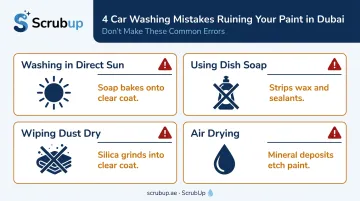
Most paint damage in Dubai happens not from the heat itself, but from how cars are washed in it. These four mistakes are the biggest culprits:
- Washing in direct sunlight — soap and water evaporate before you can rinse, and baked-in soap residue etches the clear coat. Shade or early morning washing is non-negotiable.
- Using dish soap or household detergents — these strip wax and paint sealants in a single wash. Dubai's UV then works directly on unprotected paint.
- Wiping dust off dry panels — dragging a dry cloth across a dusty car grinds silica particles into the clear coat. Always pre-rinse or use a waterless wash solution to encapsulate dust before any contact.
- Air drying after washing — even a few minutes of wet panels in midday sun leaves hard mineral deposits. Dry immediately with a clean microfiber cloth.
How to Protect Your Car Between Washes in Dubai's Summer
Apply Protection After Every Wash
Bare, unprotected paint oxidises and fades faster under Dubai's UV exposure. Applying car wax or a synthetic paint sealant after washing creates a barrier that slows UV degradation, repels dust bonding, and makes subsequent washes easier.
Meguiar's recommends waxing 3–4 times per year for maximum protection. In Dubai's harsher conditions, more frequent reapplication makes sense — especially after summer washes.
Apply wax in shade only. Turtle Wax notes that applying wax in direct sunlight causes the product to dry too quickly, leaving streaks and residue.
Keeping up with wash frequency is itself a form of paint protection. Regular cleaning prevents baked-on contamination from etching into the clear coat — and ScrubUp's mobile service makes it straightforward to stay on schedule without rearranging your day.
Wash Frequency in Dubai's Summer
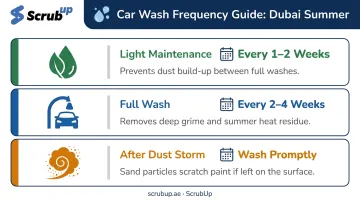
A car left unwashed for too long in Dubai's summer accumulates baked-on contamination that requires more aggressive cleaning methods to remove — which itself carries higher scratch risk. The general guidance for Dubai's dust levels and heat:
- Light-duty maintenance: every 1–2 weeks with a waterless solution or eco wash
- Full wash: every 2–4 weeks depending on parking exposure and driving frequency
- After dust storms or heavy construction dust: wash promptly — sitting contamination bonds faster in heat
If keeping to that schedule around a busy Dubai summer isn't practical, ScrubUp's mobile service brings the right products and equipment directly to your location. Book via the app, at book.scrubup.ae, or on WhatsApp.
Frequently Asked Questions
Is it okay to wash my car in hot weather in Dubai?
Yes, if done in the right conditions. Shade, cooler hours, and heat-compatible products are what separate a safe wash from a damaging one. Washing a hot car in direct sunlight causes soap and water to evaporate before rinsing, leaving water spots and surface etching. Early morning or late evening in a covered location avoids this entirely.
Can you wash your car in public in Dubai?
No. Public car washing is prohibited under Dubai Local Order No. 11 of 2003, which bans discharging vehicle washing water in any non-designated location. Car washing must take place in designated facilities or private covered parking. Violations carry fines under Dubai Municipal law.
What is the best time of day to wash a car in Dubai?
Before 9 AM or after 6 PM. Surface temperatures are notably lower during these windows, UV intensity drops, and products have time to work before evaporating. DEWA identifies 12 PM–5 PM as peak summer heat — avoid washing during this period.
How often should I wash my car during Dubai's summer?
More frequently than in cooler climates. A light maintenance wash every 1–2 weeks and a full wash every 2–4 weeks is a reasonable baseline. After dust storms, wash promptly. Baked-on dust in Dubai's heat bonds to paint faster and takes far more effort to remove.
Can I use dish soap or household detergent to wash my car in Dubai?
No. Household cleaners are not pH-balanced for automotive paint, strip protective wax in normal conditions, and work even faster in Dubai's heat. Meguiar's notes that dish soap can accelerate paint oxidation. Use automotive-specific shampoo only.
What is a waterless car wash and is it suitable for Dubai?
A waterless car wash uses a solution that encapsulates dust and lifts it from the surface without water. It suits Dubai well: flash evaporation isn't a factor, it aligns with water conservation guidelines, and it handles the fine desert dust that settles daily. Apply in straight lines using clean microfiber only.