According to Bilt Hamber's technical guide on ferrous fallout, nearly all vehicles are contaminated by metallic particles from braking surfaces and industrial fallout, and the corrosion these particles generate can swell within the clear coat and deteriorate the surrounding paint film. Left unchecked, that means dull, pitted paint that wax cannot restore — and paint correction costs in Dubai starting from AED 1,500 for a single stage.
Paint decontamination removes these bonded contaminants safely. But it's also one of the most commonly mishandled detailing processes, particularly in Dubai's extreme heat. Getting it wrong causes more damage than skipping it entirely.
Key Takeaways
- Decontamination removes bonded contaminants (iron fallout, tar, mineral deposits) that washing cannot reach
- Follow three stages in order: chemical iron removal, tar removal, then clay bar treatment
- Always work on cool, shaded surfaces — never in direct Dubai sun
- Adequate clay lubricant is non-negotiable; dry claying causes irreversible micro-scratches
- Always finish with a protective layer — wax, sealant, or ceramic coating — after decontamination
What Is Paint Decontamination and Why It Matters
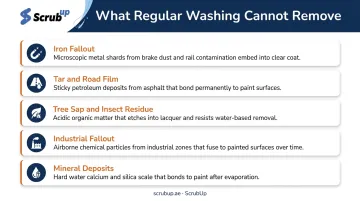
Paint decontamination targets "bonded contaminants" — particles that physically embed into or chemically fuse with the clear coat. A pressure washer or snow foam cannot dislodge them. They require either a chemical reaction or mechanical removal to lift.
The Main Contamination Types
- Iron fallout — microscopic metallic particles from brake dust (your own brakes and surrounding traffic), industrial emissions, and rail carriages; Bilt Hamber notes these corrode beneath the surface, causing paint film to deteriorate around each embedded particle
- Tar and road film — petrochemical residue that bonds to lower panels and sills
- Tree sap and insect residue — acidic organic matter that etches into clear coat
- Industrial fallout — airborne particles from nearby construction, manufacturing, and ports; a 2025 UAE road-dust study covering Dubai and Al Ain documents heavy-metal contamination in arid urban environments from both anthropogenic and natural sources
- Mineral deposits — hard water spots that etch into the surface if left to dry repeatedly
Where Decontamination Fits in the Detailing Sequence
Decontamination sits after washing and before polishing or applying any protective coating. This sequence isn't flexible. Polishing over contaminated paint grinds embedded particles across the clear coat, creating fresh scratches with every pass.
The Plastic Bag Test
Before you start, confirm whether decontamination is actually needed. Run a clean hand inside a plastic bag across a freshly washed, dry panel. A smooth, glass-like surface means your paint is clean. If it feels rough, gritty, or like sandpaper, bonded contamination is present.
This diagnostic — documented by detailing educator Mike Phillips at Autogeek — takes 30 seconds and tells you exactly which decontamination steps to skip and which to prioritize.
Safety Precautions Before You Start
Baseline Rules
Before any decon product touches paint, confirm:
- The car is pre-washed — loose grit must be removed first; dragging dry particles across paint during decon causes scratches that defeat the entire process
- Panels are cool to the touch — not warm, not "not hot enough to burn you"; cool
- The car is in shade or covered parking — never work in direct sunlight or outdoors mid-afternoon in summer
Chemical Handling
Iron fallout removers contain reactive chelating agents. The red-purple colour change is the reaction working — it's also a sign the chemistry is aggressive. Handle accordingly:
- Wear nitrile gloves throughout
- Avoid eye contact; keep the product bottle away from your face when spraying
- Never let iron removers dry on the surface — product dwell times vary significantly by brand: Bilt Hamber Korrosol specifies 15 seconds to 5 minutes on cool surfaces; Gtechniq W6 allows 3 to 5 minutes but must not dry; Meguiar's Ultimate Iron Remover recommends just 30 seconds
- Tar removers are solvent-based — apply to affected areas only, not across entire panels
Preparing Your Vehicle Safely
Pre-washing is not optional. It's the step that makes every subsequent stage safer — and it's what allows decon chemicals to work on contamination rather than sitting on top of loose grit.
For Dubai car owners dealing with sand-heavy contamination, a thorough pre-wash using pH-balanced, paint-safe products is non-negotiable. ScrubUp's Pressure Wash service handles this stage with foam pre-treatment and high-pressure rinsing — removing embedded dust and road residue before any contact work begins.
Working in Dubai's Climate
Dubai's summer temperatures present a genuine chemical safety risk. UAE automotive media reports dashboard sensor readings of 55°C when outside air is 45°C — and parked-car studies in comparable hot climates record unshaded interior air temperatures reaching 70°C. Exterior paint panels in direct sun absorb heat to similar extremes.
On surfaces that hot, chemical decon products begin to dry and etch in a fraction of their intended dwell time.
Practical rules for Dubai decontamination:
- Work in early morning or after sunset for DIY sessions
- Use basement or covered parking wherever available — temperature and light conditions are dramatically safer
- Never attempt outdoor decon between 10am and 5pm from May to September
- If you touch a panel and it's warm, wait

ScrubUp's technicians work across basement parking in Dubai communities including Downtown Dubai, Dubai Hills Estate, and Arabian Ranches — where conditions stay controlled regardless of the time of day.
How to Safely Decontaminate Your Car Paintwork Step by Step
Stage 1 – Chemical Iron Fallout Removal
Iron fallout removers work by converting embedded ferrous particles into a water-soluble compound through chelation. The purple bleed across the panel surface confirms the reaction is active.
Safe application method:
- Spray onto a cool, wet surface — not dry paint
- Allow to dwell for the manufacturer-specified time (check your specific product — ranges vary from 30 seconds to 5 minutes)
- Watch for the colour change to peak and begin slowing — that's your rinse cue
- Rinse thoroughly with clean water before moving to the next stage
Don't limit this stage to lower panels. Brake dust and industrial fallout settle across entire vehicles, including roofs and bonnets. Treat the full painted surface.
With iron fallout cleared, the next stage targets petrochemical contamination that chemical decontaminants can't touch.
Stage 2 – Tar and Adhesive Removal
Tar removers are solvent-based. They work by dissolving petrochemical residue so it lifts onto a cloth rather than spreading.
Method:
- Apply to affected areas only — not across full panels
- Allow brief dwell: CARPRO TarX specifies 2 to 3 minutes, with a hard limit of 7 to 10 minutes maximum
- Wipe with a clean microfibre using light, dabbing movements — never firm rubbing or circular pressure
- The solvent is doing the work; your cloth is collecting it
Critical step after tar removal: Re-wash the entire vehicle with car shampoo before moving to the clay stage. CARPRO's official TarX instructions specify this explicitly. Solvent residue on the surface interferes with the next stage and contaminates clay media.
Once the surface is chemically clean and re-washed, clay decontamination handles whatever bonded particles remain.
Stage 3 – Clay Bar Decontamination
Claying is the mechanical stage. It physically lifts any remaining bonded particles from the clear coat surface — no chemicals involved.
Choose the right grade. Fine or medium clay is appropriate for most vehicles. Coarse clay removes more aggressively but carries a significantly higher risk of marring, especially on softer clear coats.
Core safety rules:
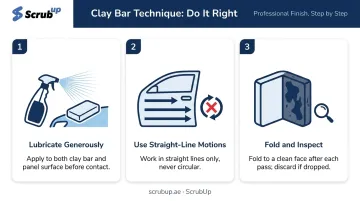
- Apply generous clay lubricant to both the clay bar and the panel surface before any contact
- Work panel by panel in small sections using straight-line motions with light pressure — Chemical Guys' clay guide specifically warns against circular motion because of swirl risk
- The clay should glide freely. If it drags, add more lubricant immediately
Inspection and disposal:
- Fold the clay bar regularly to expose a clean surface as it picks up contamination
- Discard the clay bar immediately if dropped on the ground — Bilt Hamber's Auto-Clay guidance is explicit on this point; grit picked up from the floor transfers directly onto paint on the next pass
- A dirty clay bar used without folding causes the same scratching it was meant to prevent
Common Safety Mistakes That Damage Paint
These are the errors that turn a protective process into a damaging one:
- Applying decon chemicals to a hot or sun-heated surface — the product dries before its reaction completes, leaving behind residue that etches the clear coat; in Dubai summers, this is the most common cause of decon-related paint damage
- Under-lubricating during clay bar use — dry or under-lubricated claying causes clay marring that shows up on dark-coloured vehicles as a dull haze of fine scratches; the damage is often worse than the original contamination
- Applying protection over contaminated paint — bonded contaminants sealed under wax, sealant, or ceramic coating continue corroding the clear coat from beneath; any money spent on protection is wasted if the surface wasn't properly prepared first
Conclusion
Safe decontamination comes down to three things: the right sequence (pre-wash → chemical decon → clay → protection), clean and cool surface conditions, and product discipline — correct dwell times, adequate lubrication, no shortcuts.
Treat it as a planned part of routine car care — twice a year minimum, or before any polishing or coating session. For Dubai drivers, the local conditions make this especially important: fine sand, intense heat, brake dust from stop-start traffic, and industrial fallout from nearby zones all accelerate surface contamination. A mobile wash service like ScrubUp can handle the pre-wash and foam stages at your location, but the clay and protection steps are yours to own. The plastic bag test takes 30 seconds to confirm whether it's time.
Frequently Asked Questions
What is paint decontamination?
Paint decontamination is the process of removing bonded contaminants — iron fallout, tar, tree sap, and mineral deposits — that physically embed into the clear coat. These particles cannot be removed by regular washing alone, regardless of shampoo strength or pressure.
What are the types and stages of paint decontamination?
There are two main types: chemical (iron fallout removers, tar removers) and mechanical (clay bar). The three stages run in sequence — iron fallout removal, tar and adhesive removal, and clay bar decontamination — each targeting a different category of bonded contaminant.
How often should I decontaminate my car's paintwork?
Clay decontamination is best done two to three times per year as part of a regular detailing routine. In Dubai, add a session after any dusty period and always before polishing or applying a new protective coating.
Can I decontaminate my car in hot weather or direct sunlight?
No. High surface temperatures cause iron fallout removers and tar removers to dry before their reaction is complete, leaving residue that etches the clear coat. Work in shade or covered parking, during early morning or evening hours — particularly between May and September.
Is a clay bar safe for all types of car paint?
Clay bars are safe on standard clear-coated paint when used with adequate lubrication. Do not use clay on matte or satin finishes — the abrasive action can create permanent shiny spots on these surfaces by introducing unwanted gloss.
Do I need to apply protection after decontaminating my paint?
Yes — always. Decontamination strips existing protective layers alongside the contaminants. Leaving paint bare after decon exposes the clear coat directly to environmental fallout. Apply wax, sealant, or ceramic coating as the final step to lock in results.