Most people underestimate what poor drying actually does. Water spots aren't just cosmetic nuisances. As USGS explains, hard water contains dissolved calcium and magnesium that remain on surfaces as residue when water evaporates — and removing those deposits gets progressively harder the longer they sit.
This guide covers everything: the right tools, correct technique, the environmental variables that affect results, and the mistakes that undo an otherwise good wash.
Key Takeaways
- Standing water deposits calcium and magnesium minerals that form stubborn water spots — particularly with hard tap water
- High-GSM microfiber towels are the only paint-safe drying material — chamois, bath towels, and paper towels all risk scratching
- Always dry in shade, work top to bottom, and blot — never drag or wipe
- Blow out door jambs, grilles, and mirror bases before reaching for a towel — not after
- Poor rinsing leaves soap or grit on panels — any towel contact over residue causes micro-scratches
Why Drying Your Car After Washing Actually Matters
Water doesn't just disappear off a car panel — it evaporates and leaves everything it was carrying behind. Meguiar's describes hard-water spots as mineral deposits that require chemical breakdown to remove. Ford's exterior-care guidance goes further, explicitly telling owners to dry the vehicle after washing to eliminate water spotting. This isn't detailing folklore — it's manufacturer-backed advice.
The Mineral Residue Problem
Hard water is high in dissolved calcium and magnesium. When a droplet evaporates on a sun-baked panel, those minerals concentrate and bond to the clear coat surface. The longer they remain, the harder removal becomes. In Dubai's heat, the window from wet droplet to hardened deposit can close in minutes.
The Abu Dhabi Department of Energy's 2025 Water Quality Regulations set the regional benchmark for total hardness at 300 mg/L as CaCO3 — firmly in the hard water range by USGS classification. UAE tap water carries real mineral load. That means every drop left to dry on your paint is depositing something.
Heat and UV as Risk Multipliers
Dubai's climate data shows peak UV Index values reaching 12 — classified as extreme by WHO. High temperatures accelerate surface evaporation, cutting the time you have to towel a panel before minerals start drying down. UV exposure also degrades unprotected clear coat over time, and a roughened surface from water spot etching only speeds that process along.
Trapped Water and Corrosion
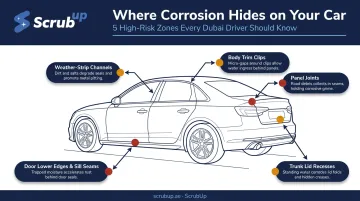
Water that seeps into panel gaps, door seals, and trim recesses doesn't dry quickly. As Armoloy's corrosion research explains, stagnant water in confined spaces creates oxygen-depleted pockets that accelerate metal corrosion — a process known as crevice corrosion. The most vulnerable spots on a typical car include:
- Door lower edges and sill seams
- Trunk lid recesses and weather-strip channels
- Panel joints and body trim clips
What You Need to Dry Your Car Properly
The right tools determine whether drying protects or scratches. There are three categories that matter.
Microfiber Drying Towels
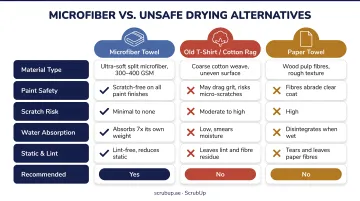
Microfiber's split-fiber construction traps particles within the cloth rather than dragging them across the panel. This is the key difference between microfiber and every alternative.
Choose towels based on where you're using them:
- 600+ GSM for body panels — more towel mass means more absorbency buffer between the paint and any trapped particle
- 220–400 GSM waffle-weave for glass and tight areas — lower pile reduces lint and streaking on smooth surfaces
- Clean, freshly laundered towels every time — never reuse a towel that's been dropped or used on dirty surfaces
Skip these alternatives entirely:
- Bath towels — coarse cotton fibers scratch clear coat and leave lint
- Chamois leather — no particle-trapping buffer; anything on the surface gets dragged across it
- Paper towels — surprisingly abrasive at a microscopic level
- Old t-shirts — variable texture and embedded debris risk
Detailing Blower or Compressed Air
A dedicated car detailing blower is essential. Towels physically cannot reach water sitting inside grilles, behind badges, in mirror bases, door jambs, fuel cap recesses, and wheel spokes. Without a blower, that water drips onto already-dried panels minutes later, creating fresh streaks.
If using compressed air instead, ensure it's filtered and moisture-free.
Drying Aid or Quick Detailer Spray
A drying aid reduces surface tension so water beads and slides off more readily, adds lubrication between towel and paint to reduce micro-friction, and leaves a light protective gloss layer. In Dubai's heat, panels dry fast and surfaces can turn tacky within seconds. A drying aid keeps the towel gliding smoothly and gives your paint an added layer of protection on the final pass.
How to Dry a Car After Washing: Step-by-Step
Sequence matters. Skipping or reordering these steps is how water spots, swirl marks, and streaks get introduced.
Towel drying safety depends entirely on rinse quality. If soap residue or road grime remains on the panel, any towel movement drags those particles across the clear coat.
ScrubUp's Pressure Wash service uses high-density foam combined with pH-balanced, calibrated pressure to remove road film, sand, and contaminants — so the surface reaching the drying stage is genuinely clean rather than superficially rinsed.
Step 1: Final Rinse and Water Sheeting
A thorough top-to-bottom rinse removes all soap, foam, and loosened grit. Any residue left behind becomes an abrasive once the towel moves.
After the final rinse, angle the water stream so it flows in flat sheets down the body panels. This sheeting technique removes the bulk of surface water before any towel makes contact — reducing both drying time and the number of passes needed.
Step 2: Blow Out Hidden Water Traps First
This step must happen before towel drying, not after. Water blown out of door jambs onto an already-dried door panel creates new streaks and defeats the work done.
Key areas to target with the blower:
- Door jambs and rubber seals
- Underside of wing mirrors
- Front grille and badge recesses
- Fuel filler cap surround
- Trunk/boot seal gap
- Wheel spokes and brake caliper areas
Step 3: Dry Body Panels Top to Bottom
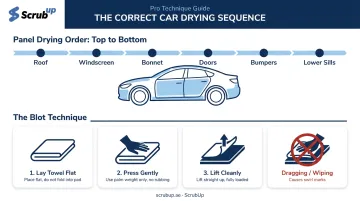
Work in this sequence: roof → windscreen → bonnet → doors → bumpers → lower sills. Starting at the roof ensures any residual drips fall onto still-wet panels below, not onto sections you've already dried.
Correct technique — blotting, not wiping:
- Lay the microfiber flat onto the panel
- Press gently with the palm
- Lift cleanly
Do not drag, scrub, or wipe sideways. The towel's own weight and absorbency does the work. Dragging introduces friction and presses any remaining micro-particles against the clear coat — that's how swirl marks form.
Step 4: Address Glass and Trim Separately
Body-panel towels leave lint and smearing on glass. Use a dedicated lower-GSM or waffle-weave towel specifically for windows and windscreens.
Dry external rubber trim, plastic mouldings, and door seals thoroughly, then treat with a trim protectant spray. Dubai's high UV environment degrades unprotected plastics noticeably faster than in temperate climates — skipping this step means visible fading within months.
Step 5: Final Inspection and Drying Aid Application
Do a visual walkthrough in shade. Open all doors, the boot, and the fuel cap to check interior jambs for drips that emerged post-blowing. Run your eye across each panel at a low angle — this reveals streaks or water beads invisible from standing height.
For the final pass with drying aid: mist lightly onto a clean, slightly damp microfiber cloth and wipe in one direction. This removes any remaining haze, adds gloss, and leaves a thin protective layer that helps resist the next round of dust and water contact.
Key Factors That Affect Your Drying Results
Even with the right tools and sequence, four variables determine whether the outcome is perfect or problematic.
Ambient Temperature and Sun Exposure
| Condition | Risk |
|---|---|
| Drying in direct midday Dubai sun | Water evaporates in seconds on exposed panels — before the towel reaches them |
| Drying in shade or covered parking | Controlled evaporation rate; towel can work faster than water dries down |
| Surfaces hot to the touch | Towel friction increases as surface becomes tacky; mineral deposits harden faster |
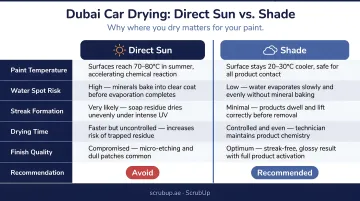
Always dry in shade. Covered basement parking or early morning before direct sun hits the vehicle are the best scenarios in Dubai.
Towel GSM and Cleanliness
GSM measures fabric mass per square metre — higher GSM means more towel material buffering the paint from any particle. But GSM alone doesn't make a towel safe. A high-GSM towel laundered with fabric softener, or dropped on the ground and reused, causes more damage than a fresh lower-GSM towel used correctly.
Fabric softeners deposit hydrophobic chemical layers on microfiber strands, blocking the capillary channels that make the material absorbent. As textile research confirms, these agents reduce fiber-to-fiber contact — so the towel smears water rather than lifting it.
To keep your towels safe to use:
- Wash detailing towels separately, without fabric softener
- Inspect for contamination or debris before each use
- Never reuse a towel that's been dropped on the ground
Water Hardness
The harder the water used for washing, the more mineral content sits on the surface waiting to be removed. Regional regulatory benchmarks from Abu Dhabi's DoE place acceptable total hardness limits at 300 mg/L as CaCO3 — placing UAE water firmly in categories where mineral residue after evaporation is a real and consistent concern.
Pre-Wash and Rinse Quality
This is the variable most people overlook. If road film, sand, or soap foam remains when drying begins, the towel acts as a delivery mechanism for abrasion. A thorough two-stage wash — pre-wash decontamination followed by a proper main wash and complete rinse — creates a surface that is safe to dry. Cut the wash short, and drying will cause damage no matter which towel you reach for.
Common Drying Mistakes to Avoid
Most drying damage comes down to the same few errors — wrong materials, wrong conditions, or skipped steps that seem minor until you see the results on paint.
Air drying or driving off: Water evaporation doesn't remove minerals — it concentrates them. Moving air picks up fresh road dust and deposits it onto wet surfaces, leaving results worse than a proper water spot.
Drying in direct sunlight: Panels dry in patches before towels can reach them. In Dubai, this is a risk for most of the year, not just peak summer.
Wrong cloth, wrong outcome: Chamois has no particle buffer. Bath towels scratch with coarse cotton fibers. Paper towels are abrasive at a microscopic level. None are substitutes for purpose-made microfiber.
Skipping the blower step: Door jambs, mirror bases, and grille recesses hold significant water volume. That water emerges minutes after towel drying — dripping down panels and door seals, leaving streaks and accelerating rubber seal deterioration.
Contaminated towels cause invisible damage: Fabric softener residue blocks microfiber strands, turning an absorbent towel into a smearing cloth. It feels soft but delivers no paint protection — and potentially introduces fine scratches from reduced lubrication.
Frequently Asked Questions
What happens if I don't dry my car after washing?
Skipping drying allows mineral-rich water to evaporate and leave calcium and magnesium deposits on the clear coat. In Dubai's hard-water, high-sun conditions, those deposits form quickly and become progressively harder to remove without chemical treatment.
What is the best tool to dry a car without scratching?
A high-GSM (600+) twisted-loop microfiber towel combined with a drying aid spray is the safest choice for body panels. Use a waffle-weave microfiber for glass. Both work best with the blot-and-lift technique; never drag them across the surface.
Can I use a regular towel to dry my car?
No. Bath and kitchen towels use coarser cotton fibers that scratch clear coat and shed lint. Chamois leather, while smooth, offers no particle-trapping buffer. Only purpose-made automotive microfiber towels have the fiber construction needed to dry safely.
Should I dry my car in the sun or in the shade?
Always dry in the shade. Direct sun causes water to evaporate faster than it can be toweled away, leaving mineral deposits on hot paint. In Dubai, early morning or covered parking spots are the best drying environments year-round.
How long does it take to properly dry a car?
A thorough dry using microfiber towels and a blower typically takes 15–25 minutes depending on vehicle size. Rushing leads to missed areas and drips that re-emerge from door jambs onto finished panels.
Do I need a drying aid if I'm already using a microfiber towel?
Not strictly required, but worthwhile. A drying aid reduces surface tension, adds lubrication during the final pass, and leaves a light protective gloss — particularly useful in Dubai's heat, where surfaces dry fast and the towel needs more working time.