The good news: cleaning your engine at home is manageable. The bad news: done wrong, it causes electrical faults that cost far more to fix than the clean was worth.
This guide covers what to prepare, how to do it safely step by step, what commonly goes wrong, and when it makes more sense to call a professional.
Key Takeaways
- Always clean a cool engine — never hot, never running
- Cover the battery, fuse box, alternator, and ignition wires before spraying anything
- Use a water-based or citrus degreaser; petroleum-based products degrade rubber hoses over time
- Rinse with a garden hose on a gentle stream — pressure washers force water past seals and into connectors
- Never DIY engine-wash a hybrid or electric vehicle — high-voltage components create serious safety risks
What You Need Before Cleaning Your Car Engine
Preparation separates a safe, effective engine clean from one that shorts out a sensor or strips paint. Gather everything before water or chemicals enter the picture.
Safety Checks First
The engine must be cool to the touch before you start. Ford's owner manual explicitly warns never to wash or rinse a hot or running engine — water in a running engine can cause internal damage, and cold water on a hot block risks cracking it from rapid thermal contraction. Wait at least 15 minutes after the engine has been running; in Dubai's heat, waiting longer is sensible.
Also disconnect the negative battery terminal before introducing any liquid. On most vehicles, this is simple — locate the black-capped terminal, loosen the nut, and lift the cable clear.
On newer vehicles with complex battery management systems, disconnecting the battery can trigger restart procedures or clear stored settings. Check your owner's manual first.
Tools and Materials You'll Need
- Degreaser — water-based or citrus enzyme formula only. Avoid petroleum-based products: Parker's chemical guide confirms EPDM rubber (the most common radiator and coolant hose material) has poor resistance to petroleum-based fluids
- Soft-bristle synthetic brushes — two or three sizes for tight crevices
- Microfibre towels — at least three or four clean ones
- Plastic bags and rubber bands or tape to cover electrical components
- Garden hose with adjustable nozzle — set to gentle stream or mist, never pressure washer
- Disposable gloves — engine degreasers are alkaline and can irritate skin
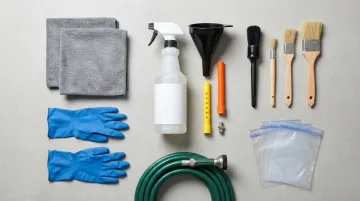
With your safety checks done and materials ready, you're set to start cleaning without risking damage to sensors or hoses.
How to Clean Your Car Engine at Home: Step-by-Step
Done in order, these steps protect sensitive components while still getting the engine bay genuinely clean. Skipping steps or changing the sequence is where most DIY mistakes happen.
Step 1: Clear Loose Debris First
Before any liquid touches the engine bay, remove visible debris — leaves, sand, and dust buildup around the battery, along the firewall, and inside air intake channels. Use compressed air or a dry soft brush. In Dubai, fine sand packs into every gap; skipping this step means turning that sand into abrasive mud the moment degreaser hits it.
Step 2: Protect Electrical Components
Cover these components before anything else:
- Battery and battery terminals
- Fuse box and power distribution box
- Ignition coil and spark plug wires
- Alternator
- Any exposed sensors, connectors, or wiring looms
Use plastic bags secured with rubber bands or tape. The goal isn't to make the engine waterproof — it's to prevent direct water contact with components that short easily. Ford's manual specifically instructs owners to never wash or rinse ignition coils, spark plug wires, or spark plug wells — not even with bags on.
Step 3: Apply Degreaser
Spray from the bottom up, working across the entire engine bay. Give heavier buildup areas — the valve cover, lower engine block, any spots with visible oil residue — an extra pass or longer dwell time.
Dwell time is product-specific: Simple Green specifies 3–5 minutes before rinsing; CRC Industries calls for 10–15 minutes. Follow the directions on whichever product you use — don't assume a universal rule applies.
Use a long-handled parts brush to agitate caked-on areas before rinsing. Keep overspray away from painted fenders, as degreaser strips wax from painted surfaces.
Step 4: Rinse Carefully
Use the garden hose on its gentlest stream setting. Rinse from the back of the engine bay toward the front, so contaminated water flushes forward and out — not back over areas you've already cleaned. Direct the stream away from covered electrical components.
Never use a pressure washer. Hyundai's owner manual warns it can cause electrical circuit failure, and Peugeot's manual prohibits high-pressure washing in the engine compartment entirely.
Even Simple Green — a company that sells engine degreaser — recommends staying at least 3–5 feet back if a pressure washer is used. That distance makes it effectively useless for this job.
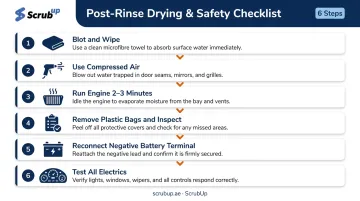
Step 5: Dry Thoroughly and Reconnect
Done rinsing? Don't close the bonnet and walk away.
- Blot and wipe all accessible surfaces immediately with clean microfibre towels
- Use compressed air in bolt recesses, nooks, and around the battery terminals if available
- Run the engine for 2–3 minutes — the heat evaporates moisture trapped in places towels can't reach
- Remove all plastic bags and inspect that nothing was missed
- Reconnect the negative battery terminal
- Test all electrics — windows, lights, instrument cluster — before closing the bonnet
Key Factors That Affect How Well Your Engine Cleans Up
The same process produces very different results depending on three variables.
Degreaser Type and Dwell Time
Water-based degreasers are safer for rubber components and paintwork but need adequate contact time to break down oil. Petroleum-based products cut through grease faster but are not suitable for regular use — EPDM rubber (used in most coolant hoses) has poor resistance to petroleum-based fluids, which accelerates cracking and seal failure over time. For a once or twice-yearly clean, a quality water-based formula is the safer option.
Water Pressure and Rinsing Direction
Too much pressure forces water past plastic bags and into connectors. Rinsing back-to-front ensures runoff carries grime away from cleaned areas rather than back over them.
Engine Temperature at Cleaning Time
A cold engine causes degreaser to bead off hardened grease without penetrating. On the other end, a hot engine causes chemicals to evaporate instantly and risks burns or thermal cracking. The safe window is a fully cooled engine — cool to the touch — after an appropriate rest period following driving.
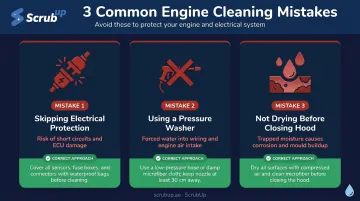
Common Mistakes When Cleaning a Car Engine at Home
Most DIY engine cleaning failures come from a short list of repeated errors.
Skipping electrical protection Never skip covering the battery, fuse box, and ignition components before you start. Toyota's Prius v owner manual explicitly warns that water inside the engine compartment can cause electrical components to catch fire. An NHTSA technical bulletin similarly documented water intrusion into a battery module triggering a resistive short — a real risk on any vehicle, not just hybrids.
Using a pressure washer High-pressure water forces past seals and gasket covers, soaks connectors, and can crack brittle plastic housings on older engines. A garden hose on stream or mist is far safer, regardless of how dirty the engine is.
Not drying before closing the hood Trapped moisture around battery terminals, the alternator, and spark plug wells invites corrosion and can cause electrical shorts. When the engine heats up, that moisture expands into contact points. Run the engine for a few minutes after wiping down — don't skip this step.
When DIY Engine Cleaning Makes Sense — and When It Doesn't
DIY works well when:
- The vehicle is a standard petrol or diesel car
- You have outdoor or covered-but-ventilated parking where water can drain away safely
- The engine has moderate buildup — not years of caked grease and oil leaks
- You can follow the full process without rushing
Under these conditions, cleaning every 6–12 months is achievable without specialist equipment.
DIY is not suitable for:
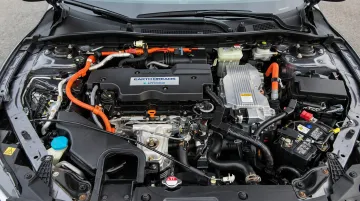
- Hybrid and electric vehicles — Toyota's Prius v manual explicitly warns against applying water inside the engine compartment, and Nissan's 2024 LEAF manual identifies high-voltage components up to DC 400V, warning that contact can cause severe burns or fatal electric shock
- Luxury vehicles with densely packed sensors and open intake systems
- Apartment basement parking in Dubai, where drainage is limited and the confined space makes rinsing impractical
- Any situation where you'd need to rush — a half-done engine clean with damp connectors is worse than a dirty one
Dubai has over 34,970 registered EVs as of October 2024 according to DEWA, and that number is growing. For EV owners, the engine bay is off-limits for DIY cleaning — the professional route is the only safe one.
For residents who can't safely clean at home, whether because of vehicle type, parking setup, or time constraints, ScrubUp's mobile Steam Wash service (AED 105) brings trained technicians directly to your parking spot in Dubai.
The service uses controlled high-temperature steam at 170°C to remove grime with minimal water, and technicians are equipped to work within basement and gated community parking without needing drainage access. Bookable via WhatsApp, the mobile app, or the website.
Frequently Asked Questions
What are the signs of a dirty engine?
Look for dark, oily residue or caked grime on the engine block, sand and debris packed around the battery or air intake, and reduced airflow visible around the radiator or fan housing. A persistent burning smell when the engine warms up — caused by oil residue on hot metal — is another reliable indicator.
Can I clean my car engine with water?
Yes, but only with a low-pressure garden hose and only after all electrical components are fully covered. The goal is a gentle rinse to remove degreaser, not a soak. Never use a pressure washer or jet nozzle in the engine bay.
How often should I clean my car engine?
For most vehicles in Dubai's dusty climate, once every 6–12 months is a reasonable baseline. Vehicles driven frequently on sandy roads, near construction, or in industrial areas may benefit from cleaning closer to the 6-month mark. Most manufacturers note that dusty and desert conditions accelerate wear on vehicle components.
Is it safe to clean a car engine at home?
It is safe for standard petrol or diesel vehicles if the engine is cool, electrical components are protected, and a low-pressure rinse is used. Hybrid and electric vehicle engine bays should always be left to professionals; the high-voltage risk cannot be managed safely with household DIY methods.
What happens if water gets on engine electrical parts?
Water on connectors, the fuse box, or ignition wires can cause short circuits, misfires, warning lights, or sensor failures. Symptoms may appear immediately or only after the engine heats up and trapped moisture expands into contact points, so drying thoroughly before closing the bonnet is essential.
Can I clean a hybrid or electric car engine at home?
No. Hybrid and EV engine bays contain high-voltage components (up to DC 400V in some vehicles), along with exposed wiring harnesses and sealed modules that should only be cleaned by trained technicians using controlled dry or steam-based methods.
Conclusion
Cleaning your car engine at home is entirely achievable, provided the engine is cool, electrics are protected, you're using the right degreaser, and you rinse gently. The process takes patience and attention to order, but nothing about it is technically beyond a careful home mechanic.
Most failures trace back to the same three mistakes: skipping the electrical protection step, reaching for a pressure washer, or leaving moisture behind when the job is done. Avoid those, and the result is a noticeably cleaner engine bay that's easier to inspect and less prone to heat-related grime buildup.
Certain vehicles — EVs, hybrids, and luxury cars with exposed sensor arrays — make DIY genuinely unsuitable. For Dubai residents in that position, ScrubUp's Steam Wash service is a practical alternative: trained technicians come directly to your parking spot, use controlled vapor steam rather than water flooding, and handle the job without you managing drainage, hose access, or high-voltage risk.