Introduction
Dubai's roads don't forgive neglect. Between daily desert dust, sandstorms that arrive without warning, and UV exposure intense enough to bake grime into clear coat within days, cars here deteriorate faster than in most other climates. A bucket and sponge can only do so much — dragging sand across your paint with a mitt is exactly how scratches happen.
An electric pressure washer changes the equation. The right model strips off road film, dust, and brake residue efficiently, with far less contact risk than hand washing. The wrong one can strip wax, lift clear coat, or force water into door seals. Too much pressure, the wrong nozzle — both are easy mistakes with real consequences.
That distinction matters. According to Car and Driver's 2026 pressure washer testing, 3,000 PSI can strip paint outright, while the 1,000–1,800 PSI range is where car-safe cleaning actually happens.
If you're washing a car in Dubai's conditions, choosing the right machine from the start saves your paint — and your money.
Key Takeaways
- 1,200–2,000 PSI is the safe operating range for car paint — stay under 2,500 PSI
- Use 25–40 degree nozzles at 12–24 inches from the surface; never use a 0-degree tip on paint
- Rated PSI often exceeds actual tested output; for cars, the lower real-world figure is safer
- The Worx Nitro Hydroshot is the only genuinely cordless option, as all others require a power outlet
- Dubai residents with basement or gated parking may find ScrubUp's mobile wash more practical than buying equipment
Why Electric Pressure Washers Are the Go-To Choice for Car Detailing
Electric pressure washers run off a standard power outlet and use an electric motor to pressurise water. They're quieter than gas models, lighter, and most importantly for car owners, they operate within a PSI range that's workable for automotive surfaces.
Gas-powered washers are a different category entirely. They're built for concrete, decking, and heavy-duty surfaces, and their pressure output typically far exceeds what painted car panels can handle safely. Consumer Reports warns that even electric models can nick paint if pressure and nozzle selection aren't considered carefully — which is why the right setup matters more than raw output.
Electric models also offer practical advantages that matter in everyday use:
- Start instantly with no warm-up or fuel prep
- Run without fumes, making them safe for covered parking and building basements
- Lightweight enough to carry between floors or across a residential compound
- Require no fuel storage or management between washes
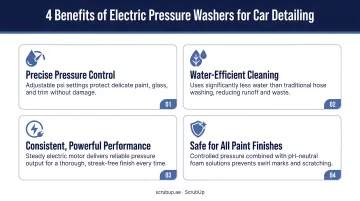
For Dubai residents cleaning cars in apartment basements, gated community bays, or shared parking areas, these differences are genuinely useful.
Those practical strengths shaped the selection criteria below. The five models were chosen for car-safe PSI output, nozzle variety, and real-world usability, not just peak power ratings.
Top 5 Best Electric Pressure Washers for Car Detailing
These five models were selected based on PSI accuracy, car-safe pressure output, nozzle versatility, build quality, and value for money.
Kärcher K5 Classic — Best Overall for Versatility
Kärcher is one of the most widely distributed pressure washer brands globally, and the K5 Classic sits at the upper end of their consumer range — capable enough for patio surfaces and exterior walls, but calibrated for car use with the right lance.
The K5 Classic's standout feature for car detailing is the Vario Power spray lance, which allows pressure adjustment on the wand itself without swapping nozzles. That level of control is useful when moving from heavily soiled wheel arches to more sensitive bonnet panels.
The unit also includes built-in accessory storage, a telescopic handle for transport, and an 8-metre high-pressure hose that handles most full-size vehicles without repositioning.
| Spec | Detail |
|---|---|
| Max Pressure | 20–145 bar (adjustable) |
| Flow Rate | 500 L/h (approx. 8.3 L/min) |
| Hose Length | 8 metres |
| Key Features | Vario Power lance, dirt blaster, front hose storage, detergent suction hose |
| Best For | Car detailing + home surface cleaning |
One note: the 10-metre hose is specific to the K5 Premium and Power Control variants, not the standard K5 Classic. Verify the exact variant before purchasing, as Kärcher's product line uses the K5 name across multiple configurations.
Craftsman CMEPW2100 — Best for Beginners
The Craftsman CMEPW2100 is quick to set up and genuinely quiet compared to most units in its class — Car and Driver measured it at 82 dBA, making it viable for residential parking areas without attracting complaints.
Its stated 2,100 MAX PSI drops to real-world figures that land squarely in the car-safe range. Car and Driver's independent testing recorded 1,800 PSI at the 15-degree tip and 1,600 PSI at the 25-degree tip — the latter being the most practical nozzle for car bodywork. The 25-foot (7.6 m) kink-resistant hose and 35-foot (10.7 m) power cord give good range, and the T-rail handle locks the wand during transport for tidy storage.
| Spec | Detail |
|---|---|
| Stated PSI | 2,100 MAX PSI |
| Tested PSI (25°) | 1,600 PSI / 1.3 GPM |
| Weight | ~28–29 lb (12.7–13.2 kg) |
| Included Nozzles | 15°, 25°, 40°, soap, turbo |
| Hose / Cord | 25 ft (7.6 m) hose / 35 ft (10.7 m) cord |
For car use, stick to the 25-degree or 40-degree nozzles. The turbo nozzle included with this unit concentrates pressure in a rotating pattern — avoid using it on painted panels.
Chemical Guys ProFlow PM2000 — Best for Car Detailing Enthusiasts
The PM2000 Pro was designed with the automotive detailing community in mind, and that focus shows in the accessory selection. It ships with four nozzle tips (15°, 25°, 40°, and 60°), a compact wash gun, an extended barrel attachment, and a 25-foot (7.6 m) flex hose.
The 360-degree lockable caster design makes it easy to rotate around a vehicle without dragging the unit.
At 13.2 lb (6 kg), it's notably lighter than most competitors, which matters in tight parking bays where you're constantly repositioning. The detachable onboard organiser keeps cables and nozzles sorted. Foam cannon compatibility is built into the design — Chemical Guys sells PM2000 Pro kits that include a foam cannon, making pre-soak setup a natural part of the workflow.
| Spec | Detail |
|---|---|
| Rated PSI | 2,030 MAX PSI |
| Rated GPM | 1.77 GPM |
| Standard Output | ~1,350 PSI / 1.06 GPM |
| Weight | 13.2 lb (6 kg) |
| Dimensions | 14 × 9 × 8.25 in (35.6 × 22.9 × 21 cm) |
| Foam Cannon | Compatible (kits available) |
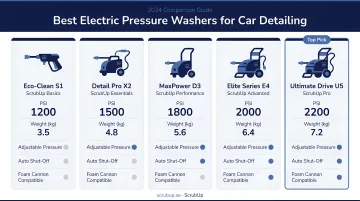
The 60-degree nozzle included here is useful for rinsing foam off panels without risk — a tip you won't find in most competitor bundles.
Greenworks GPW2000 — Best Budget Pick
The Greenworks GPW2000 doesn't overcomplicate things. Plug it in, connect the hose, and it works — no steep learning curve, no fiddly setup. It's one of the more plug-and-play options in this price range.
Greenworks lists two variants with slightly different GPM ratings (1.1 GPM and 1.2 GPM depending on the specific model number), so check the exact SKU when purchasing. Both deliver 2,000 PSI at the rated output, a 20-foot (6 m) high-pressure hose, a 35-foot (10.7 m) cord with inline GFCI protection, and an onboard detergent tank for soap application.
| Spec | Detail |
|---|---|
| Rated PSI | 2,000 PSI |
| Rated GPM | 1.1–1.2 GPM (variant dependent) |
| Hose / Cord | 20 ft (6 m) hose / 35 ft (10.7 m) cord |
| Weight | 29.1 lb (13.2 kg) |
| Included Nozzles | 25°, 40°, soap (standard kit) |
| Motor | 13-amp with start/stop technology |
Note: No independent dBA measurement is available for this model. The 40-degree white nozzle is the safest choice for painted car surfaces with this unit.
Worx Nitro 40V Hydroshot WG647 — Best Cordless Option
The Hydroshot WG647 solves a problem none of the other models on this list address — no power outlet near your parking spot. Running off two 20V batteries in series (40V total), it operates completely independently of mains power and can draw water from any fresh-water source: a bucket, a tap, or a storage container.
The trade-off is pressure: the WG647 is rated at 800 MAX PSI with standard output around 550 PSI. That's well below corded options, but for a car that needs a maintenance wash rather than heavy decontamination, it works. Lower PSI also means less risk to paint — particularly relevant for newer cars or vehicles with vinyl wraps.
| Spec | Detail |
|---|---|
| Power Source | Two 20V 2.0Ah batteries (40V combined) |
| MAX PSI | 800 PSI |
| Standard PSI | ~550 PSI |
| GPM | 0.92–1.0 MAX GPM |
| Weight | 4.37 lb (2 kg) with batteries |
| Nozzle | 5-in-1 multi-spray |
For anyone in Dubai's apartment buildings without basement power access, or for quick in-between washes, this is the most practical portable option available.
Key Factors to Consider When Choosing an Electric Pressure Washer for Your Car
PSI (Pressure Output)
Car and Driver's testing recommends 1,000–1,800 PSI as the conservative sweet spot, with up to 2,200 PSI workable for most vehicles with the right nozzle angle. Above 2,500 PSI, the risk of stripping wax, lifting clear coat, or forcing water into door seals increases significantly.
"MAX PSI" on the box is a marketing figure. As ProToolReviews explains, "PSI Max" represents peak output under ideal lab conditions, and real-world nozzle output is usually lower. That's not a defect; it just means tested PSI at a 25-degree nozzle is the number that actually matters.
GPM (Water Flow Rate)
GPM determines how quickly you can rinse soap and displaced dirt off the surface. Car and Driver notes that 1.2–2.5 GPM covers most detailing tasks comfortably. A moderate-PSI unit with stronger flow can outperform a high-PSI, low-flow machine when it comes to efficient rinsing and foam distribution.
Nozzle Selection
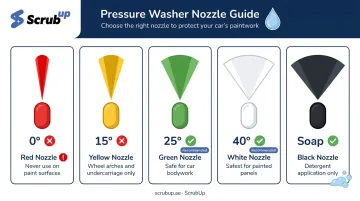
CarPro recommends the 25-degree (green) and 40-degree (white) nozzles for safe automotive washing. The 15-degree tip is acceptable for heavily fouled wheel arches and undercarriages. Consumer Reports warns that the red 0-degree nozzle can pierce surfaces. Keep it away from painted panels entirely.
Hose Length and Cord Management
The corded models reviewed here use 20–25 foot hoses, which cover most passenger vehicles adequately. Cord length (typically 35 feet) becomes a real-world concern in basement parking, where the nearest outlet may be further than expected. Always check both figures before buying.
Portability and Storage
Wheels, lightweight frames, and onboard accessory storage matter more than they seem — especially when washing in tight basement bays or carrying equipment across a parking lot. The Chemical Guys PM2000 (13.2 lb) and Worx Hydroshot (4.37 lb) lead on portability; the Craftsman and Greenworks units are heavier but more stable on uneven surfaces.
How We Chose These Pressure Washers
Each model was assessed on how well it performs in real automotive use, not just on spec sheet numbers. The criteria:
- Car-safe PSI range — output that cleans effectively without risking paint damage
- Stated vs. tested output — how closely real-world performance matches advertised figures
- Nozzle variety — availability of 25-degree, 40-degree, and foam cannon options
- Ease of setup — time from unboxing to first spray
- Build quality — hose length, connector durability, and motor housing
- Foam cannon compatibility — thread size and flow rate support for detailing use
Suitability for automotive use drove every decision.
The most common mistake buyers make is selecting a pressure washer based on the highest PSI number on the box. That figure rarely reflects what the unit delivers at a 25-degree nozzle from 18 inches away — the only context that matters when washing a car.
Conclusion
The best electric pressure washer for car detailing isn't the most powerful one. It's the one that delivers the right pressure range, gives you nozzle options, and fits your actual parking situation.
Before buying, assess three things: where you park (basement, street, gated lot), whether you have reliable power and water access, and how often you'll actually use it. A corded unit like the Chemical Guys PM2000 or Craftsman CMEPW2100 makes sense if you have consistent access to both. The Worx Hydroshot solves the cordless problem, at the cost of lower pressure output.
For Dubai residents who park in basements, gated communities, or locations where setting up pressure washing equipment isn't practical, ScrubUp's mobile car wash service is a direct alternative. The Pressure Wash tier (AED 75) uses high-pressure equipment with pH-balanced foam application, calibrated to be safe on paint. Technicians come to your parking spot fully equipped: no water or power required from your side.
Book via the ScrubUp website, the mobile app (iOS / Android), or WhatsApp at +971 50 900 5014.
Frequently Asked Questions
Is 3,000 PSI too strong to wash a car?
Yes. Car and Driver's testing confirms that 3,000 PSI can strip paint and damage surfaces. Most automotive detailing professionals recommend staying under 2,000 PSI for painted panels, and well under 2,500 PSI even for wheel arches and undercarriages.
What PSI is safe for washing a car without damaging the paint?
The safe range is 1,200–2,000 PSI with a 25–40 degree nozzle, held 12–24 inches from the surface. That keeps pressure gentle enough for clear coat and wax while still cutting through road grime.
Should I use a foam cannon with my electric pressure washer?
Yes. A foam cannon pre-soaks the vehicle with pH-neutral shampoo, loosening dirt before you rinse. This reduces the pressure needed and keeps the wash gentler on paint.
What is the best nozzle angle for car detailing?
The 25-degree (green) and 40-degree (white) nozzles are the safest for general car washing. The 15-degree tip can handle wheel arches and undercarriages. Never point a 0-degree or turbo nozzle at painted bodywork.
Electric vs. gas pressure washer — which is better for car detailing?
Electric models are the clear choice. They run quieter, weigh less, start instantly, and top out at PSI levels that are safe for automotive paint. Gas-powered washers are built for industrial surfaces, not car bodywork.
How often should I pressure wash my car in Dubai?
Auto Trader UAE recommends washing at least once every two weeks in Dubai's conditions. During sandstorm periods, more frequent washing prevents abrasive dust from bonding to clear coat under the heat.