For Dubai drivers specifically, this is compounded by heat. Research on enclosed vehicles found that cabin temperatures can reach 57–68°C when ambient air exceeds 30°C — conditions that accelerate bacterial growth and bond odour molecules deeper into carpet fibres. Add food spills, AC condensation, wet shoes, and the occasional pet, and carpet odour becomes one of the most common interior complaints in the UAE.
This guide covers the most common causes, a step-by-step removal process, the best odour eliminators matched to specific smells, and when the problem genuinely requires professional help.
Key Takeaways
- Match your cleaner to the source: enzymes for biological odours, vinegar for mildew, activated charcoal for absorption
- Complete drying is the most skipped and most critical step; damp carpet restarts the problem within 24 hours
- Dubai heat makes carpet smells worse and gives you less time to act before bacteria establish
- Petrol or chemical smells require a mechanic, not a cleaning session
- Recurring smells after cleaning point to trapped moisture or an underlying structural problem
Common Causes of Car Carpet Smell
Why Carpet Holds Odour Longer Than Other Surfaces
Car carpet isn't just fabric — it's a layered system of tufted or woven synthetic fibres bonded to foam padding. Research published in Building and Environment describes carpet fibres as high-surface-area structures that behave as a sink for chemical and microbial contaminants, accumulating more contamination per unit area than hard flooring. A vinyl floor panel can be wiped clean; carpet stores the residue and keeps re-emitting it.
The Four Main Culprits
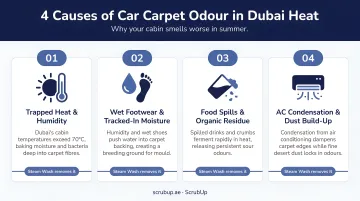
Most car carpet smells trace back to four sources — and understanding which one you're dealing with shapes the fix:
- Food and beverage spills: Sugary drinks, coffee, and food residue seep through the pile into foam padding, where bacteria produce sour or rotten compounds. The smell often intensifies hours or days after a spill, because bacterial activity builds up in the padding where surface cleaning doesn't reach.
- Moisture and mildew: Wet shoes, umbrellas, rain through door seals, or AC condensation leave carpet damp. The EPA's mould guidance notes that materials dried within 24–48 hours typically avoid mould growth — beyond that window, the musty, earthy smell becomes difficult to remove without treating the moisture source directly.
- Pet odour and cigarette smoke: Pet dander, fur, and biological residue work into the padding over time. Cigarette smoke deposits nicotine and semi-volatile compounds that bond to fibres and persist for months. Fragrance sprays make no meaningful difference with either.
- Dubai's summer heat: Interior temperatures in parked cars can reach 57–68°C, speeding up bacterial growth and chemically embedding odour compounds deeper into fibres. Smells that might fade in a cooler climate tend to persist and worsen in the UAE.
How to Identify the Source Before You Start
Most cleaning attempts fail because the source is never actually found. The smell comes back within days, unchanged.
Run a physical inspection first:
- Remove all floor mats and check underneath for forgotten food, damp items, or discolouration
- Press down firmly on the carpet — hidden moisture pockets feel spongy under pressure
- Look for fuzzy or discoloured patches indicating mould growth, particularly under seats and near the door sills
- Check the front footwells for AC drain overflow (passenger side is common)
Use location as a diagnostic clue:
- Smell strongest in the driver footwell → dirty shoes, food debris, or AC condensation
- Under rear seats → children's snacks, pet contamination
- Throughout the whole cabin equally → AC system or widespread moisture problem
One important safety note: A petrol, fuel, or sharp chemical smell is not a cleaning issue. Mechanics warn that a petrol smell inside the cabin can indicate a fuel leak or a faulty fuel system component. Have a mechanic inspect it before attempting any interior cleaning.
How to Remove Smell from Car Carpet: Step-by-Step
Skipping steps — especially the drying stage — is why most DIY attempts fail. Follow this in order.
Step 1: Clear and Vacuum Thoroughly
Remove all floor mats and loose items. Vacuum the carpet in multiple passes using an upholstery attachment, paying close attention to seat creases, door sill edges, and under the pedals. Run a stiff brush over the surface first to bring deeply embedded debris to the pile before the final vacuum pass.
Step 2: Treat the Specific Odour Source
Target the cause, not just the smell:
- Food or drink spills — Blot up as much residue as possible before applying any cleaner. Don't rub; blotting prevents the residue spreading deeper into the foam
- Mould or mildew — Apply a diluted white vinegar solution (equal parts water and vinegar) or an antifungal spray before the main cleaning step
- Pet odour or biological contamination — Use an enzyme-based cleaner specifically; standard carpet shampoo won't break down the organic compounds responsible
Step 3: Deep Clean the Carpet
Apply an automotive-grade carpet shampoo or upholstery cleaner. Spray onto the affected area, work it into the fibres with a soft-to-medium brush using circular motions, and allow it to dwell for 10–15 minutes.
Then use a wet-dry vacuum to extract the dirty water and cleaning solution. Passive evaporation leaves residue and moisture behind, so extraction isn't optional.
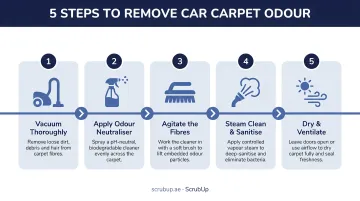
Step 4: Apply an Odour Neutraliser
After cleaning, apply a dedicated odour neutraliser, not an air freshener. Air fresheners mask the smell temporarily; effective neutralisers contain enzymes or oxidising agents (such as chlorine dioxide) that break down odour-causing compounds at a molecular level.
Mist the neutraliser over the entire carpet surface and allow it to dry fully before the next step.
Step 5: Dry Completely Before Reinstalling
This is the most critical step and the most frequently skipped. Reinstalling damp mats or closing the car before the carpet dries fully will restart mould and mildew growth within 24 hours.
- Park with all doors open in a well-ventilated area
- Use a fan aimed at the footwells if available
- Allow a minimum of several hours — in Dubai's humidity, overnight drying is safer
- Press down on the carpet before reinstalling mats; if it still feels cool or damp, it's not ready
Best Odour Eliminators for Car Carpet
The key distinction is between odour maskers (fragrance sprays, air fresheners) and odour neutralisers that actually break down the compounds causing the smell. Maskers provide temporary relief and can layer scent over unresolved sources, making the underlying problem harder to identify next time.
| Product | Best For | How It Works | Limitation |
|---|---|---|---|
| Baking soda | Mild general odours | Neutralises acidic and basic odour molecules without adding fragrance | Surface only; won't treat deep foam or mould |
| White vinegar (diluted) | Mildew, bacteria, sour smells | Bactericidal effect; 3% acetic acid shows antimicrobial activity | Test a small area first; don't use on leather |
| Activated charcoal pouches | Ongoing passive absorption after cleaning | Adsorbs odour molecules into porous surface; effective for residual VOCs | Passive tool, not for active wet carpet treatment |
| Enzyme cleaners | Food, pet waste, sweat, milk, urine | Enzymes break down protein, starch, and fat compounds at molecular level | Wrong choice for smoke, fuel, or structural mould |
How to Apply Each Product
- Baking soda — Sprinkle generously over completely dry carpet, leave for several hours or overnight, then vacuum thoroughly. Works best as a finishing step after cleaning and drying, not as a standalone fix for persistent smells.
- White vinegar — Mix equal parts water and white vinegar in a spray bottle, mist lightly onto the carpet, and allow to air dry. The vinegar smell dissipates completely once dry.
- Activated charcoal — Place pouches under the seats for several days after cleaning to passively absorb any remaining odour traces.
When to Call a Professional Car Cleaning Service
Some situations fall outside what DIY methods can resolve:
- Mould is visible across a large carpet area
- The carpet remains damp after repeated cleaning (indicates a water ingress or drainage issue)
- Health symptoms — coughing, eye irritation, or respiratory discomfort — appear inside the car
- Odours return within 24–48 hours of a thorough cleaning session
Professional interior cleaning addresses each of these scenarios through methods that aren't accessible at home. ScrubUp's Steam Wash service uses controlled vapour at 170°C to penetrate carpet fibres, seats, mats, and vents, killing odour-causing bacteria and dissolving embedded grime without saturating the carpet with water.
Industrial-grade wet vacuums also extract far more moisture than consumer tools. IICRC technical guidance notes that specialist extraction equipment removes up to 97% of moisture from carpet and padding, compared to around 40% from standard wands.
For Dubai residents, ScrubUp's mobile service means a technician comes directly to your parking spot — whether that's a residential building basement, gated community, or office parking — fully equipped with steam machines, professional vacuums, and eco-friendly, biodegradable products. No need to transport a smelly car across the city.
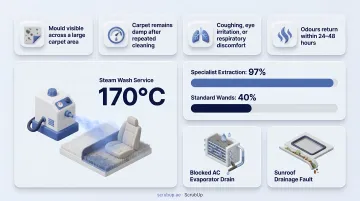
Professional cleaning also gives a technician the chance to spot structural causes most car owners miss. Blocked AC evaporator drains are a leading cause of wet passenger-side carpet, and sunroof drainage faults cause similar problems. Consumer Reports notes that a mouldy or musty car smell can result directly from a blocked AC drain. Clean the carpet without fixing the drainage, and the smell returns as soon as the AC runs again.
How to Prevent Car Carpet Smells from Returning
Act immediately on spills. The difference between a quick clean and a professional treatment is almost always response time. A spill absorbed in the first few minutes stays near the surface pile; left for hours, it soaks into the foam padding where bacteria establish before any cleaning begins. Keep paper towels or a small microfibre cloth in the car for this reason.
Improve ventilation habits:
- Crack windows when parked in shaded areas to let trapped moisture escape
- Run the fan on fresh air mode (not recirculate) periodically to dry out the cabin
- Remove wet items — gym bags, umbrellas, wet shoes — rather than leaving them on the carpet
Schedule regular professional interior cleaning. In Dubai's climate, heat and humidity accelerate bacterial growth year-round, meaning odour compounds build up faster than in cooler environments. A deep interior clean every three to four months prevents buildup from reaching the point where intensive treatment is needed.
ScrubUp's interior cleaning starts at AED 49 for routine maintenance vacuuming and goes up to AED 105 for a full steam treatment. Because the service comes directly to your parking spot, staying on top of interior maintenance takes no extra time out of your day.
Frequently Asked Questions
How long does it take to get rid of smell from car carpet?
Mild odours can be resolved in a single cleaning session, though the carpet must dry completely (often overnight) before the smell fully clears. Severe mould or smoke odours may require multiple treatments or professional intervention over several days.
Can baking soda permanently remove car carpet odour?
Baking soda absorbs surface odours effectively but doesn't eliminate the bacterial or organic source. It works well as a finishing step after the source has been removed and the carpet cleaned — not as a standalone solution for persistent or deep-seated smells.
Why does my car carpet still smell after cleaning?
The most common reason is moisture trapped in the carpet padding, which allows bacteria to regrow. The odour source, such as mould, spill residue in the foam, or a structural water leak, may also not have been fully removed.
Is white vinegar safe to use on car carpet?
Diluted white vinegar (equal parts water) is safe for most synthetic car carpets and is effective against mildew and bacteria. Don't use it on leather surfaces, and the vinegar smell dissipates completely once the carpet dries.
Does Dubai's heat make car carpet smells worse?
Yes. High interior temperatures accelerate bacterial growth and cause odour molecules to bind more deeply into carpet fibres. Parked cars in Dubai reach extreme cabin temperatures that amplify existing smells, making same-day spill response and regular maintenance more important than in cooler climates.
When should I replace car carpet instead of cleaning it?
Consider replacement if mould has reached the subfloor, the carpet was saturated by flood damage, or repeated professional cleaning hasn't eliminated the smell. Most cases are resolved with professional deep cleaning well before replacement becomes necessary.