This guide covers everything you need to know: what auto detailing actually is, what's included, how the process works step by step, why it matters for your vehicle's long-term condition, and why Dubai's climate makes it more than just a cosmetic choice.
Key Takeaways
- Auto detailing is a professional, multi-stage restoration process — not a faster car wash
- Coverage spans both exterior surfaces (paint, wheels, glass) and the full interior cabin
- Routine detailing protects paint from UV damage, oxidation, and contamination
- For routine upkeep between details, mobile wash services like ScrubUp handle exterior and interior cleaning at your parking spot across Dubai
What Is Auto Detailing?
The International Detailing Association defines auto detailing as the thorough cleaning, reconditioning, and protection of both a vehicle's interior and exterior — a meticulous, step-by-step process that can take several hours and requires trained professionals assessing every crevice and surface.
That's a different process entirely from a standard car wash.
| Car Wash | Auto Detailing | |
|---|---|---|
| Goal | Remove surface dirt | Restore, correct, and protect |
| Process | Rinse, foam, dry | Decontaminate, polish, seal |
| Time | 10–20 minutes | Several hours |
| Who does it | Automated or quick-service | Trained detailing professional |
| Result | Clean surface | Restored finish |
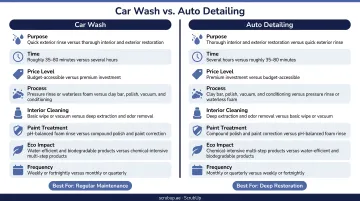
Detailing treats every component individually — wheels, door jambs, leather seats, dashboard crevices — in a way no automated wash can replicate. Where a car wash removes visible dirt, detailing works at the surface level: correcting paint, eliminating contaminants, and sealing finishes against future wear.
The global car detailing market is projected to reach USD 2.7 billion by 2030, growing at roughly 10% annually — a figure that reflects how seriously vehicle owners worldwide treat this kind of care.
One important caveat: the IDA notes there are no uniform industry standards for what a "detail" includes. Packages vary significantly by provider, so always confirm exactly what's covered before booking.
What Does Auto Detailing Include?
Auto detailing breaks down into three areas: exterior, interior, and full-package services — each targeting a different part of the vehicle.
Exterior Detailing
Exterior detailing covers every surface on the outside of the vehicle — paint, glass, wheels, tyres, trim, and chrome. Key services typically include:
- Decontamination wash to remove road grime, brake dust, and surface debris
- Clay bar treatment to extract bonded contaminants (iron particles, tar, tree sap) that washing alone won't lift
- Machine polishing with abrasive compounds to reduce swirl marks, micro-scratches, and oxidation
- Paint protection via wax, synthetic sealant, or ceramic coating to seal the corrected surface
Interior Detailing
Interior detailing goes well beyond vacuuming. A professional interior detail typically covers:
- Deep vacuuming of seats, carpets, and boot
- Steam cleaning of upholstery, fabrics, and hard-to-reach areas
- Dashboard, console, and door panel cleaning
- Leather conditioning to prevent cracking
- Interior glass cleaning
- Odour elimination using specialist products or steam treatment
Full Detailing and Add-Ons
A full detail combines exterior and interior services into one package — ideal for vehicles overdue for a full clean or being prepared for resale.
Common add-ons include:
- Paint correction for deeper scratch removal
- Ceramic coating for long-term paint protection
- Headlight restoration
- Engine bay cleaning
- Pet hair removal
The Auto Detailing Process: Step by Step
Step 1 — Washing
The initial wash removes surface dirt, road grime, and debris before any correction work begins. Modern detailers use three main approaches:
- High-pressure rinse wash with shampoo — the standard approach for heavily soiled vehicles
- Rinseless wash — a bucket concentrate that loosens dirt using minimal water
- Waterless wash — encapsulating sprays that lift dust particles off paint with no water required
Step 2 — Decontamination
Washing alone doesn't remove everything. Chemical fallout removers dissolve iron particles and industrial deposits, while clay bar treatment extracts bonded contaminants embedded in the paint surface. The result is a smooth, clean surface ready for paint correction.
Step 3 — Paint Correction
This is where visible imperfections get addressed. Using abrasive compounds and machine polishers, a detailer works through the clear coat to reduce:
- Swirl marks from improper washing
- Micro-scratches and light surface damage
- Oxidation and haze from UV exposure
Light surface scratches can often be corrected at this stage. Deep scratches that penetrate through the clear coat may require professional bodywork.
Step 4 — Protection
The final stage seals the corrected paint and determines how long that finish holds up. The main options differ considerably in durability:
| Protection Type | Durability | Notes |
|---|---|---|
| Carnauba wax | 4–8 weeks | Sits on paint surface, washes away over time |
| Spray sealant (e.g. Gyeon WetCoat) | Up to 12 weeks | Hydrophobic, easy to apply |
| Ceramic coating (e.g. CARPRO CQuartz) | 18–24 months | Bonds to paint, chemical resistant |
| Professional ceramic (e.g. Gtechniq Crystal Serum Ultra) | Up to 9 years | Professional application required |
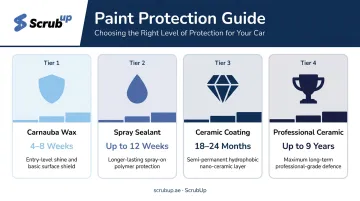
The right choice depends on how much protection you need and how often you're willing to reapply — durability figures assume regular maintenance washes in between.
Why Auto Detailing Matters
Paint Protection
UV radiation is one of the primary causes of paint-coating degradation — it breaks chemical bonds in the clear coat's binder layers, leading to fading, cracking, and poor surface appearance over time. Regular detailing applies a fresh protective layer before that damage sets in permanently.
Without protection, common contaminants accelerate the deterioration:
- Bird droppings and tree sap etch into clear coat within hours in heat
- Chemical fallout from road surfaces bonds to paint and resists normal washing
- Dubai's intense sun compounds UV exposure far faster than temperate climates
Resale Value
Condition is one of the first things buyers and dealers evaluate. A car with dull paint, surface scratches, and a neglected interior will consistently fetch less than an equivalent vehicle kept in clean, maintained condition. UAE dealers and resale platforms like Dubizzle factor visible condition directly into pricing — a well-detailed car simply starts the negotiation from a stronger position.
Interior Hygiene
Research from Aston University in 2022 found that car interiors can harbour more bacteria than an average toilet, with E. coli detected in boot samples. Regular vacuuming doesn't fully address this — professional steam-based interior detailing sanitises surfaces and eliminates contaminants that settle into fabric, seams, and ventilation areas over time.
How Often Should You Get Your Car Detailed?
Most detailing professionals recommend applying paint protection at least twice a year to prevent oxidation and contamination build-up. For full professional detailing, the right frequency depends on several factors:
- Daily commuters accumulate contamination faster than weekend drivers
- Outdoor parking accelerates UV exposure and dust damage
- Harsh climates — heat, humidity, or coastal salt — call for more frequent attention
- Luxury and high-value cars typically benefit from more regular care
A practical baseline for most vehicles: full detail once or twice a year, with maintenance washes every one to three months in between.
Between full details, regular washing keeps contamination from bonding to the paint. In Dubai's conditions — fine desert sand, intense heat, and limited rainfall — that maintenance interval is shorter than most. ScrubUp recommends washing your car every two weeks to stay ahead of dust and surface build-up before it has a chance to set.
Auto Detailing in Dubai: What Makes It Different
Dubai's climate doesn't give vehicles much of a break. The UV index peaks at 9 in June and July, with sunshine averaging over 12 hours per day in summer and July temperatures reaching 39.4°C. That combination of intense UV radiation and extreme heat accelerates paint oxidation and causes interior materials (plastics, leather, foam) to degrade much faster than in temperate climates.
Then there's the dust. Fine desert sand creates an abrasive surface risk; solid particle erosion from repeated exposure can cause paint removal and clear coat delamination over time. In Dubai, this isn't a once-in-a-while problem — it's a daily reality.
Most Dubai residents live in gated communities or apartment towers with basement parking, which makes a trip to a detailing shop a genuine inconvenience. Mobile car wash services solve that directly.
ScrubUp is Dubai's mobile car wash service built for this environment. Their team arrives at your parking spot with everything needed to deliver professional-grade cleaning — whether that's a basement in Business Bay, a villa in Arabian Ranches, or a community space in Dubai Hills.
Their three service tiers address different levels of maintenance need:
| Service | Price | Duration | Best For |
|---|---|---|---|
| Eco Wash | AED 49 | 35–45 mins | Regular maintenance, light dust removal |
| Pressure Wash | AED 75 | 60 mins | Post-drive deep clean, stubborn dirt |
| Steam Wash | AED 105 | 60 mins | Deep sanitisation, odour elimination |
Each wash is designed around Dubai's specific conditions:
- Steam Wash uses controlled vapour at 170°C to kill bacteria, dissolve grease from fabric and seams, and eliminate odours without leaving excess moisture in the cabin
- Pressure Wash uses pH-balanced foam with high-density foam technology that lifts dirt before contact, reducing scratch risk
- Eco Wash applies a waterless eco-safe polymer solution that encapsulates fine sand particles and lifts them off the paint without water or abrasion
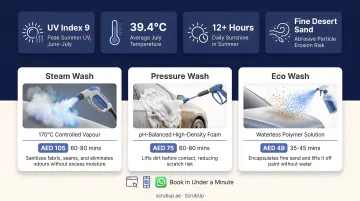
Booking takes under a minute via their website, mobile app (iOS and Android), or WhatsApp.
Frequently Asked Questions
What is auto detailing?
Auto detailing is a professional, multi-stage cleaning and restoration process covering both the exterior and interior of a vehicle. Unlike a standard car wash, it involves decontamination, paint correction, and protective treatments that restore and preserve the vehicle's condition over time.
What does auto detailing include?
A typical detail covers exterior washing, clay bar decontamination, machine polishing, and paint protection — alongside interior deep cleaning, upholstery treatment, odour elimination, and glass cleaning. Packages vary by provider, with add-ons like ceramic coating and headlight restoration available at the higher end.
What is the purpose of auto detailing?
Detailing serves two purposes: restoring the vehicle's appearance by addressing paint imperfections and interior contamination, and protecting surfaces from UV damage, oxidation, and environmental wear. Together, these extend the vehicle's lifespan and preserve its resale value.
Can auto detailing remove scratches?
Light surface scratches and swirl marks in the clear coat can be significantly reduced during the polishing and paint correction stage. Deep scratches that penetrate through the clear coat are a different matter — those typically require more intensive bodywork that goes beyond standard detailing.
How often should I get my car detailed?
Most vehicles benefit from a full professional detail once or twice a year, with maintenance washes every one to three months. In Dubai, where daily dust exposure and intense UV are constant factors, more frequent attention — particularly to exterior protection — is worth considering.
Is auto detailing worth it?
For most car owners, yes. Regular professional cleaning protects paint and interior materials from long-term damage, creates a healthier cabin environment, and supports resale value. In Dubai's dust and UV conditions, keeping on top of your vehicle's condition is practical maintenance — not an indulgence.