But which one actually lasts longer? The question matters beyond bragging rights. Reapplying a coating costs money and time, and a well-protected paint job holds resale value better.
Here's the honest answer: it depends less on the "graphene" label and more on formulation quality, how well it's applied, and how you maintain it afterward.
TL;DR
- Ceramic coatings use SiO2 to bond with paint, with documented protection typically lasting 2-5 years depending on grade
- Graphene coatings add graphene oxide to ceramic formulas; brands claim 5-9+ years, but independent verification is thin
- Application difficulty, cost, and surface compatibility vary by product—not just coating category
- Real-world durability hinges on prep and maintenance more than coating chemistry alone
- Regular gentle washing extends either coating’s life far more than the marketing label does
Graphene vs Ceramic Coating: Quick Comparison
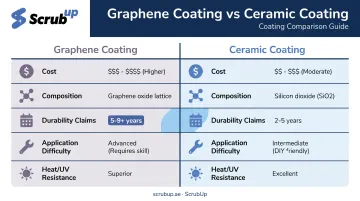
| Factor | Graphene | Ceramic |
|---|---|---|
| Cost | Higher price; usually sold as premium | Wide range: DIY sprays to pro kits |
| Composition | Ceramic resin base with added graphene oxide | Pure SiO2-based nanocoating |
| Durability claims | 5-9+ years (varies wildly by brand) | 2-5 years (more consistent across brands) |
| Application difficulty | Can be finicky on dark paint or in humid, hot conditions | Ranges from beginner-friendly to technical |
| Heat/UV resistance | Claims lower heat absorption | Proven UV resistance, but may absorb more heat |
The durability-claims row has the widest spread. Ethos Car Care lists up to 5 years for its graphene coating; Adam's claims 9+ years for a similarly categorised product. That gap alone shows "graphene" is not a reliable shorthand for longevity—especially in hot, high-UV climates where heat load and sun exposure put every coating claim to the test.
What is Graphene Coating?
Graphene coating isn't a pure graphene film on your car. It's a ceramic base infused with graphene oxide or reduced graphene oxide, typically at small percentages. Graphene's hardness, thermal conductivity, and slickness are meant to carry over into the finished coating.
For UAE drivers, the pitch is appealing:
- Improved water contact angle for better bead-off in dusty conditions
- Anti-static dust resistance, theoretically reducing sand adhesion
- Flexibility against cracking, relevant when panels expand and contract in extreme heat
You'll find two main formats: graphene spray coatings (easier DIY application, shorter lifespan) and full graphene ceramic kits (harder to apply correctly, longer claimed lifespan).
Hardness Claims Need Context
Adam's markets its Graphene Ceramic Coating Advanced at greater than 10H on the pencil hardness scale. That sounds impressive, but the International Organization for Standardization notes that pencil testing isn't reliable for comparing different coating types across labs and substrates. A 10H claim on a product page, without a linked independent test report, is a marketing number, not a verified benchmark.
Use Cases
Graphene coatings suit:
- Owners chasing maximum hydrophobic slickness and reduced water spotting
- Enthusiasts and luxury car owners wanting the newest protection technology
- Those willing to pay a premium and accept more climate-sensitive application
What is Ceramic Coating?
Ceramic coating is a SiO2-based nanocoating that chemically bonds to your clear coat. It's the older, more established technology, with a longer real-world track record than graphene.
For a car facing Dubai's sand, sun, and occasional salt air, ceramic offers:
- Hydrophobic protection that helps water and grime slide off
- Chemical and scratch resistance against everyday contaminants
- Glass-like gloss that can reduce how often you need a deep wash
Like graphene, ceramic comes in tiers. DIY consumer sprays sit at the accessible end, while professional multi-year kits, such as CARPRO's CQUARTZ line or Gtechniq's Crystal Serum, sit at the top.
A Real Data Point
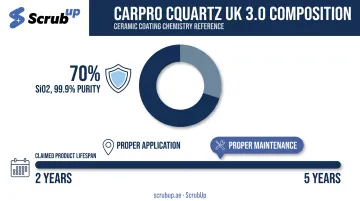
CARPRO specifies 70% SiO2 at 99.9% purity for its CQUARTZ UK 3.0 product, with a manufacturer-claimed 2-5 year lifespan. Gtechniq's Crystal Serum Light claims up to 5 years, but only with proper application and maintenance. Across reputable brands, 2–5 years is the credible lifespan band when application and maintenance are done properly.
Who Ceramic Coating Suits
Ceramic coating fits:
- Daily drivers needing reliable, proven long-term protection
- Owners who want consistent results without chasing new technology
- Anyone prioritising a documented track record over a premium price tag
Which Lasts Longer: Graphene or Ceramic?
Here's the part that surprises people: independent testing rarely shows a meaningful durability gap between a high-quality ceramic spray and a graphene-infused version of the same tier.
A 2025 scholarly review found that adding a small amount of graphene, around 0.05%, to an inorganic polymer coating improved heat resistance by 5% and corrosion resistance by 20%. Push the graphene loading higher, though, and dispersion defects can hurt performance.
That is lab formulation chemistry—not proof a bottled graphene product will outlast ceramic on your bonnet in Al Qusais.
Even Chemical Guys, a brand selling both categories, acknowledges that SiO2 has a longer documented real-world record, and that graphene's water-spot advantage remains unsettled.
So how do you choose?
- Choose ceramic if you want proven, budget-friendly, long-term protection with a more forgiving application process
- Choose graphene if you want maximum hydrophobic slickness and will pay more for an application that is more sensitive to heat and humidity
Maintenance Beats Marketing
Whichever you pick, this matters more: how you wash your car. Dubai's dust is a near-constant atmospheric presence, according to research from Khalifa University, and automated brush washes are the wrong tool for a coated finish.
Gtechniq warns that brushes and harsh conditions degrade ceramic coatings. Ceramic Pro notes that wash-site brushes can scratch the surface and void your warranty.
This is where a mobile service like ScrubUp helps protect that finish without a tunnel wash:
- Eco Wash — biodegradable, pH-balanced cleaners and soft microfiber tools that lift dust without stripping wax, sealant, or ceramic
- Pressure Wash — high-density foam for sand and road film, plus controlled-pressure rinsing instead of abrasive brush scrubbing
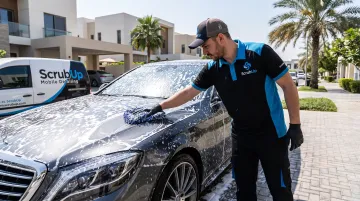
Neither approach strips the protective layer the way a stiff brush does.
Conclusion
There's no definitive winner between graphene and ceramic coating. The right choice depends on your budget, installer skill, and, more than anything, how the car gets washed day to day. A premium graphene coating applied poorly will fail faster than a budget ceramic spray maintained properly.
For Dubai drivers, the practical takeaway is simple:
- Pick a documented coating system
- Insist on proper prep before application
- Stick to a gentle washing routine every two weeks with pH-balanced foam, not automated brushes
That habit, more than any bottle label, protects your investment and stretches whichever coating you choose toward its real-world maximum lifespan. ScrubUp’s mobile washes use pH-neutral foam at your location, so keeping that two-week routine is straightforward without brushes or bay queues.
Frequently Asked Questions
Is graphene coating better than ceramic coating?
Graphene coatings are chemically similar to ceramic coatings with added graphene oxide. While they may offer marginally better slickness and heat resistance, independent tests show minimal durability advantage over high-quality ceramic.
How long does a graphene coating actually last in hot climates?
Manufacturer claims of 7-10 years assume ideal conditions. In Dubai's heat and dust, expect a shorter real-world lifespan without regular gentle maintenance.
Can I apply graphene coating over an existing ceramic coating?
This won't add meaningful protection and can even create adhesion issues. It's better to maintain one consistent coating system with proper washing.
Is ceramic coating worth it for daily drivers in the UAE?
Yes. Ceramic coating has a proven resistance to sand, sun, and heat, especially when combined with routine gentle washing every two weeks.
Does regular washing affect how long a coating lasts?
Absolutely. Harsh automated washes or abrasive brushes strip coatings faster, while gentle hand or foam-based washing preserves the protective layer for longer.
What's the biggest factor in coating longevity besides the product itself?
Surface preparation before application and consistent gentle maintenance afterward matter more than choosing graphene versus ceramic.